Hair Combing Ceremony Singapore 2026/2027
Plan a Singapore hair combing ceremony with timing, items, blessings, family roles, costs, and modern tips for Chinese weddings.
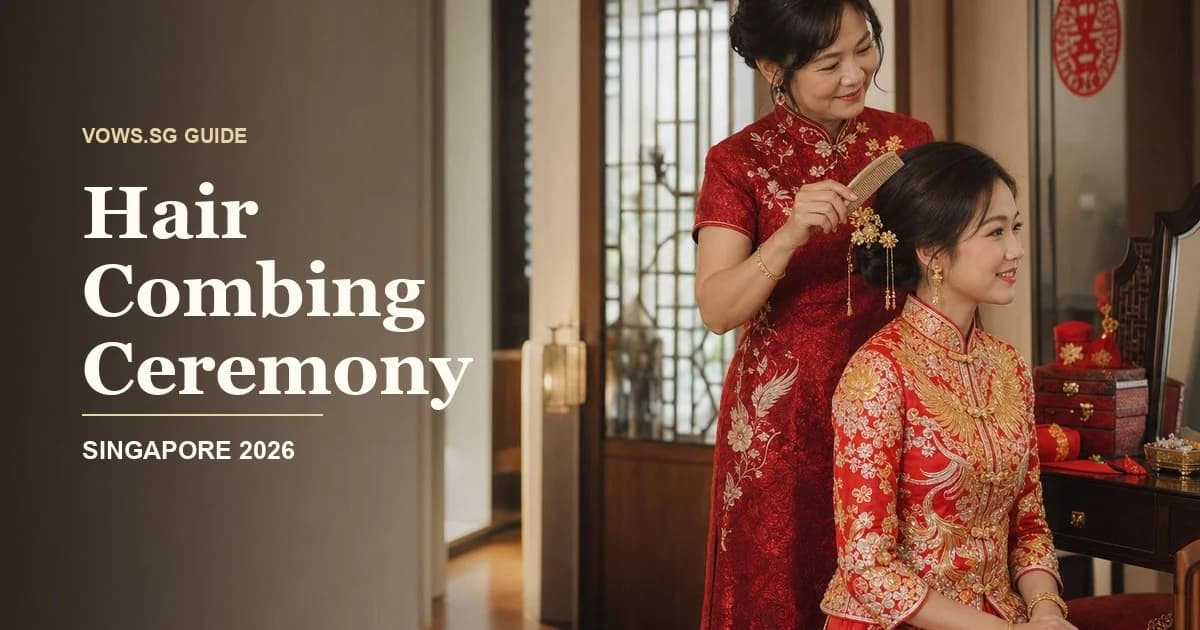
So your mum just asked, “Are you doing 上头 or not?” and you suddenly realise there is one more Chinese wedding custom hiding behind the big-ticket items.
Don’t panic. The hair combing ceremony is one of the simpler traditions to plan, and when done properly, it can be a quiet, emotional moment before the wedding madness begins. No banquet seating chart, no emcee script, no vendor coordination war. Just family, blessings, and a comb.
What Is the Hair Combing Ceremony?
The hair combing ceremony, commonly called Shang Tou (上头), is a traditional Chinese pre-wedding ritual that marks the bride and groom’s transition into married adulthood. In Singapore, it is usually done separately at the bride’s and groom’s homes on the night before the wedding, or at an auspicious hour chosen by the family.
The heart of the ritual is simple: a respected elder or “good fortune” person combs the bride or groom’s hair while saying blessings for harmony, longevity, children, and a complete marriage.
For many families, it sits alongside other Chinese wedding customs like Guo Da Li, Si Dian Jin, and the Chinese tea ceremony. It is not legally required, and it has nothing to do with your ROM status. Think of it as a family blessing ritual rather than an administrative wedding step.
Do You Need to Do It in 2026?
Need? No. Should? Depends on your family.
Many Singapore couples still do a simplified version because it matters to parents and grandparents. It is also low-cost compared with almost everything else in a wedding. If the ceremony gives your parents peace of mind and adds meaning without causing stress, it is usually worth doing.
You may want to do it if:
- Your parents or grandparents are traditional
- You are already doing Guo Da Li and tea ceremony
- Your family has dialect-specific Chinese wedding expectations
- You want a quieter family moment before the actual wedding day
- Your parents specifically asked about it, which means they probably care
You may simplify or skip it if:
- Both families are relaxed about customs
- You are having a very small ROM-only wedding
- You are not doing other Chinese customary rituals
- The auspicious timing is impractical, like 1.30am before a 5am makeup call
- One or both partners are not comfortable with the ritual
The best move is to ask both sets of parents early. Not “must we do this?” in a stressed tone, but “How does our family usually do Shang Tou?” Let them tell you what matters. Sometimes the answer is surprisingly chill.
When to Hold the Hair Combing Ceremony
Traditionally, the ceremony is held the night before the wedding after the couple has bathed and changed into new sleepwear. Some families choose a specific auspicious hour. Others simply do it after dinner, before everyone gets too tired.
In Singapore, your actual schedule matters a lot. Wedding mornings here can be brutal: gatecrash, bride fetching, tea ceremony at two homes, ROM solemnisation, hotel check-in, banquet rehearsal, photo-taking, and somehow everyone still expects you to look fresh.
| Wedding Setup | Practical Hair Combing Timing |
|---|---|
| Morning gatecrash + lunch banquet | Evening before, ideally before 10pm |
| Morning gatecrash + dinner banquet | Night before, with more flexibility |
| ROM and banquet on same day | Night before the customary wedding day |
| ROM months earlier, banquet later | Night before the tea ceremony or banquet day |
| Hotel stay before wedding | In the hotel suite, if parents are comfortable |
| BTO or new home not ready | At each family’s current home, usually HDB or condo |
| Couple already living together | Still can do separately at parents’ homes, or symbolically in separate rooms |
If your family insists on an auspicious hour that is very late, be practical. A 12.30am ceremony followed by a 4.45am makeup call is not romantic. It is sleep deprivation with red decorations. Ask whether the timing can be adjusted, especially if the next day includes a hotel lunch banquet or early restaurant tea ceremony slot.
Where to Hold It
The most common place is still the family home. A HDB living room, parents’ bedroom, or a tidy corner of the house works perfectly fine. You do not need a Pinterest-level setup.
For the bride, it is usually done at her family home. For the groom, it is done at his family home. If both sides live far apart, no issue because the ceremonies are separate. Nobody needs to travel between homes on the night before unless your family has a specific custom.
Good places to hold it:
- A clean bedroom with enough space for a chair and small table
- HDB living room with a simple red cloth setup
- Parents’ home before the couple moves into their BTO
- Hotel bridal suite, especially if the bride is staying there before the wedding
- Groom’s family home before the morning fetch-the-bride segment
If you are doing it in a hotel, check the practical bits: candles may not be allowed, smoke detectors are sensitive, and you probably should not scatter red paper all over the suite five minutes before the photographer arrives the next morning.
Who Should Comb the Hair?
Traditionally, the person combing the hair should be someone with “good fortune” - usually happily married, with children, and with living parents. In modern Singapore, families interpret this differently. Some are strict. Some just want the mother to do it because it feels meaningful.
Common choices include:
| Person | Common For | Notes |
|---|---|---|
| Mother | Bride or groom | Most sentimental and common modern choice |
| Father | Groom | Some families prefer father for son |
| Both parents | Bride or groom | Warm modern adaptation |
| Senior female relative | Bride | Auntie, godmother, or family elder |
| Senior male relative | Groom | Uncle or respected elder |
| Professional Dai Kum Jie | More traditional families | Helpful if you want someone to guide the wording |
The “right” choice depends on dialect and family expectations. If your parents have a strong view, follow that unless it creates real discomfort. If both mothers disagree on how it should be done, separate the ceremonies and let each side follow their own tradition. Don’t turn a blessing ritual into a United Nations meeting.
What to Prepare
You can keep the setup very simple. Most couples either buy a small Shang Tou package from a Chinese wedding shop or assemble the items themselves.
| Item | Purpose | Rough Budget |
|---|---|---|
| New comb | Main ritual item | S$2-S$20 |
| Mirror | Symbol of clarity and completeness | S$5-S$30 |
| Red candles or LED candles | Auspicious atmosphere | S$5-S$30 |
| Red string or ruler | Varies by dialect | S$2-S$15 |
| New sleepwear or robe | Fresh start before marriage | S$30-S$150+ |
| New slippers | Symbolic “new step” into married life | S$10-S$50 |
| Red tray or cloth | For arranging items | S$5-S$30 |
| Sweet soup ingredients | Blessings for sweetness and fertility | S$10-S$30 |
| Full ceremony package | Convenient all-in-one option | S$50-S$180+ |
Prices vary depending on quality, design, and whether you buy individual items or a full package. A basic ceremony can cost under S$50 if your family already has a mirror, tray, and candles. A prettier setup with matching robes, decorative items, and a full package may land closer to S$150-S$300.
If you are already buying Guo Da Li items, ask the same shop whether they carry Shang Tou sets. Many couples settle both at the same time to avoid another errand.
The Basic Ceremony Flow
Every family does this slightly differently, but the common Singapore version is short and manageable.
Prepare the Space
Set up a small table with the comb, mirror, candles, red tray, and any symbolic items your family wants included. Keep the area clean and uncluttered. If the photographer is coming, face the chair toward a nicer background, not the laundry rack.
The bride or groom usually bathes before the ceremony. Some families use pomelo leaves or flower water for symbolic cleansing, but many modern families simply treat it as a normal bath before changing into new sleepwear.
Change Into New Clothes
The bride and groom usually wear new pyjamas, robes, or comfortable red-toned outfits. It does not have to be dramatic. A neat silk robe, cheongsam-style sleepwear, or simple new loungewear is fine.
The idea is a fresh beginning. If your mum bought you bright red pyjamas with gold embroidery, just wear it lah. It is one night, and the photos will make everyone happy.
Light the Candles
Some families light dragon and phoenix candles, similar to what is prepared during Guo Da Li. Others use normal red candles or LED candles for safety. If you are in a hotel, use LED candles unless the hotel explicitly allows open flames.
Comb the Hair and Say Blessings
The elder combs the hair several times while saying auspicious phrases. The exact wording varies across dialect groups, but the blessings usually mean:
| Comb Stroke | Meaning |
|---|---|
| First comb | May the marriage last from beginning to end |
| Second comb | May you grow old together |
| Third comb | May the family be blessed with children and descendants |
| Fourth comb | May there be harmony, wealth, and completeness |
Some families say the lines in Mandarin. Others say them in Cantonese, Hokkien, Teochew, or Hakka. If your elder is more comfortable in dialect, let them use dialect. The feeling matters more than perfect pronunciation.
Eat Sweet Soup
After the combing, some families serve sweet soup with ingredients like red dates, dried longan, lotus seeds, and tang yuan. The symbolism overlaps with the tea ceremony: sweetness, unity, fertility, and a smooth married life.
Keep portions small. Nobody needs a full dessert bowl right before sleeping, especially with wedding-day anxiety already doing overtime.
Dialect Expectations in Singapore
This is where parents may suddenly become very specific. One family may say the bride must face a certain direction. Another may insist the groom needs a ruler, mirror, or rice sieve. Some may require a “good fortune lady”. Others only care that the ceremony happens before midnight.
Common variations include:
- Whether the bride and groom do the ceremony at the same time in separate homes
- Whether the mother, father, or both parents comb the hair
- Whether the couple must face a window, moon, or particular direction
- Whether candles must burn overnight
- Whether sweet soup is eaten before or after combing
- Whether the couple should avoid seeing each other after Shang Tou until the groom fetches the bride
If your families are from different dialect groups, let each side handle their own child according to their own custom. Unlike Guo Da Li, where the bride’s dialect group often guides the item list, Shang Tou is usually done separately, so there is room for both families to follow their own way.
Modern Singapore Adaptations That Make Sense
If You Already ROM-ed
Many couples in Singapore ROM months before the customary wedding for BTO, housing, admin, or personal reasons. That does not “cancel” the hair combing ceremony. If your families see the banquet and tea ceremony as the customary wedding day, you can still do Shang Tou the night before that.
ROM is the legal marriage. Shang Tou is the cultural blessing. Different lane.
If You Live Together Already
Very common in 2026, especially if your BTO arrived before the banquet. You can still return to your respective family homes for the night before the wedding, or do a simple version in your shared home with parents present.
If parents are traditional, sleeping separately after Shang Tou may matter to them. If they are relaxed, don’t overcomplicate it.
If You Are Staying at a Hotel
Hotel stays are convenient, especially when your makeup artist is arriving before sunrise. The bride can do Shang Tou in the suite with her parents, while the groom does his at home or in another room.
Just plan the logistics:
- Bring all ritual items in one labelled bag
- Use LED candles if open flame is not allowed
- Tell your bridesmaids not to pack the comb away by accident
- Keep the setup away from gowns, veils, and makeup tools
- Finish early enough for proper sleep
If Your Wedding Day Is Very Packed
For couples squeezing gatecrash, tea ceremony, ROM solemnisation, and lunch banquet into one day, keep Shang Tou short. Ten to twenty minutes is enough.
If your parents want a more elaborate ritual, schedule it earlier in the evening before. Do not leave it until everyone is tired and snappy. Wedding stress has a way of turning small rituals into big arguments.
How It Connects With Other Chinese Wedding Customs
The hair combing ceremony usually happens after Guo Da Li and before the actual wedding day.
A common Chinese wedding flow in Singapore looks like this:
| Timeline | Custom |
|---|---|
| 2-4 weeks before wedding | Guo Da Li |
| Before or during Guo Da Li period | Bride receives jewellery such as Si Dian Jin |
| Night before wedding | Hair combing ceremony |
| Wedding morning | Gatecrash and bride fetching |
| Wedding morning or afternoon | Chinese tea ceremony |
| Same day or separate date | ROM solemnisation |
| Lunch or dinner | Hotel or restaurant banquet |
If you are still mapping out the full sequence, use our wedding planning checklist to place the ceremony properly without overloading the week before your wedding.
Budgeting for the Ceremony
Compared with banquet tables, bridal packages, and photography, Shang Tou is tiny in the overall budget. Still, it helps to plan the cost so you don’t end up making last-minute Chinatown runs.
| Setup Type | What It Usually Includes | Rough Budget |
|---|---|---|
| Minimal | Comb, mirror, red cloth, sweet soup | S$20-S$60 |
| Standard | Ceremony package, candles, tray, sleepwear | S$80-S$200 |
| Polished | Nicer robes, decor, photographer coverage | S$200-S$500+ |
| With auspicious-date consultation | Timing advice added | S$100-S$300+ extra |
The biggest optional cost is photography. If your photographer is already covering the wedding eve or hotel prep, ask whether Shang Tou can be included. If it requires extra hours, expect a top-up. Don’t assume it is included in your wedding-day package.
For the broader wedding budget, especially if you are balancing banquet deposits, BTO renovation, honeymoon, and family customs, our Singapore wedding cost guide gives a fuller breakdown.
Common Mistakes to Avoid
- Asking parents too late. If they care about this ritual, they may also care about timing, person, direction, and items.
- Choosing an impractical auspicious hour. A blessing ceremony should not destroy your sleep before a 14-hour wedding day.
- Overbuying items nobody understands. If no one can explain why you need it, check before buying.
- Forgetting the groom’s side. Shang Tou is not just for the bride. The groom usually has his own ceremony too.
- Using real candles in a hotel without checking. Fire alarms are not part of the tradition.
- Letting family disagreements grow. Each side can follow its own dialect practice. No need to standardise everything.
- Turning it into a photoshoot only. Nice photos are great, but the point is still the blessing from family.
Practical Checklist
- Confirm with both families whether you are doing the hair combing ceremony
- Ask each side about dialect-specific expectations
- Decide the date and time, especially if using an auspicious hour
- Choose who will comb the bride’s and groom’s hair
- Decide where each ceremony will happen: HDB, condo, BTO, parents’ home, or hotel
- Buy or prepare the comb, mirror, candles, red tray, and red cloth
- Prepare new sleepwear, robe, or slippers if your family observes this
- Check whether sweet soup is needed and who will cook it
- Use LED candles if the ceremony is in a hotel room
- Pack all items in one labelled bag if moving between home and hotel
- Tell your photographer if you want the ceremony captured
- Keep the ceremony short if the next day starts early
- Confirm how Shang Tou fits with Guo Da Li, ROM, tea ceremony, and banquet timing
- Sleep early after the ceremony, because the real wedding-day marathon starts very soon
The tool for this step
Compare Wedding Venues & Packages
133 venues, 1,008 packages — filter by budget, region, and capacity
Planning your own wedding? Get every step like this one in a free personalised checklist.
Start planning freeRelated Guides
Guo Da Li (过大礼) Guide Singapore: Items, Costs & Traditions (2026/2027)
Plan Guo Da Li in Singapore with an items checklist, dialect-group differences, Hui Li, timing, realistic costs and a low-drama family process.
Wedding Dowry Traditions Singapore 2026/2027
Understand Singapore wedding dowry traditions, Guo Da Li items, pin jin etiquette, return gifts, costs, and modern family expectations.
Si Dian Jin Singapore Guide 2026/2027: Meaning, Prices, Modern Styles, Gold Choices and Family Etiquette
Buying Si Dian Jin in Singapore? Learn the meaning, 2026/2027 prices, gold types, modern styles, timing and family etiquette before Guo Da Li.