Wedding Planning in Singapore: 12-Month Checklist (2026/2027)
Wedding planning in Singapore, month by month: what to book when, ROM and HDB timing, cultural ceremonies, and a free checklist built around your date.
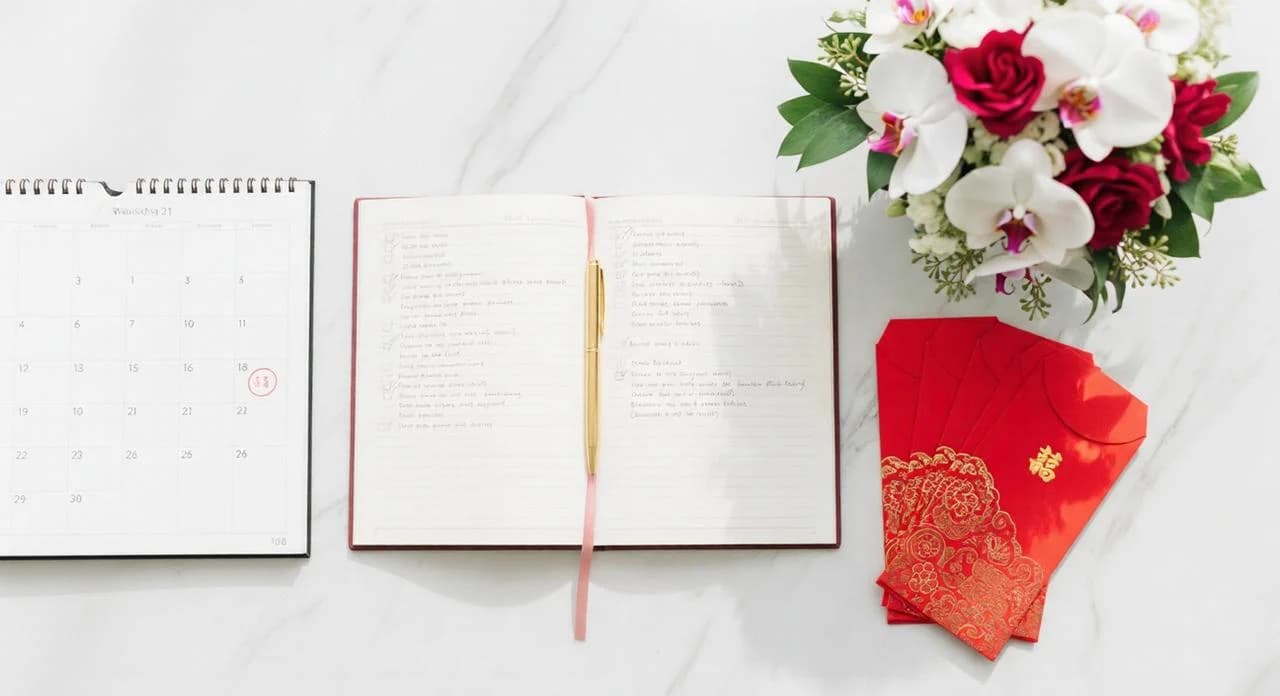
Where are you in your planning?
Put in your wedding date to see what to do now. Everything below it is the full checklist, stage by stage.
Why You Need a Singapore-Specific Checklist
A Singapore wedding planning checklist helps you coordinate your budget, guest list, venue, vendors and actual-day schedule alongside local requirements: ROM, HDB/BTO timing, and any cultural or religious ceremonies you choose to include. This guide gives you the order of work; our free planner turns it into a checklist around your own dates and traditions.
Build my free Singapore wedding plan — try the personalised checklist without signing up. It saves on this device; a free account is needed for the saved planning dashboard, including budgets, venue and vendor tracking.
This checklist is built specifically for Singapore couples getting married in 2026. It follows a 12-month countdown format, but if you have more or less time, simply adjust the timeline — the sequence of tasks matters more than the exact month.
Legal timing is separate from celebration planning. The ROM steps below cover civil marriages. Count the application window from your solemnisation date, not a later banquet: ROM requires at least 21 days' notice and allows applications up to six months ahead. For a Muslim marriage, follow the separate ROMM process.
Wedding Planning in Singapore: Start Free, Then Choose Your Support
You do not need to hire a professional just to organise a checklist or track a budget. Start by agreeing on what you can afford, how many people you want to invite, and which parts of the celebration matter to you. Then decide who will do the work: you and your partner, willing helpers, or a professional for specific responsibilities.
Your First Five Planning Decisions
- Set a spending ceiling. Include deposits, final payments and a contingency. Do not rely on expected ang bao gifts to cover commitments.
- Choose your celebration format and rough guest count. ROM-only, lunch, dinner, religious ceremony and cultural traditions create different schedules and costs.
- Shortlist dates and venues together. Check availability, capacity, minimum spend and the full written quote before paying a deposit.
- Assign responsibilities. Decide who researches vendors, updates the guest list and manages the actual day. A shared plan still needs people to carry it out.
- Build your personalised checklist. Use your solemnisation and celebration dates, which may be different, to organise what comes next.
What You Can Organise with Vows for Free
| Planning job | Where to start | What to expect |
|---|---|---|
| Work out what to do next | Personalised wedding checklist | Try without an account; your draft stays on this device. |
| Track your budget and payments | Free planning dashboard | With a free account, organise budget items and payments alongside your checklist. |
| Compare venues and keep vendor decisions together | Venue comparison and planning dashboard | Browse indicative package estimates publicly; save venue and vendor records in your account. Confirm availability and current quotes directly. |
| Organise invitations, RSVPs and seating | Wedding website and RSVP tools | A free account is needed to create and manage your wedding site; guest and seating tools are available in the planner. |
| Build an actual-day run sheet | Wedding day timeline builder | Plan the order of events and timings, then agree responsibilities with your helpers and vendors. |
Spend on the help you need, not on organisation you can comfortably handle yourself. Vows provides planning tools, not a staffed wedding-planning service: it does not negotiate contracts, make bookings for you, manage vendors on-site or resolve wedding-day emergencies. A paid planner or coordinator can be valuable if you are short on time, planning from overseas or need someone accountable for execution.
You can also combine both approaches: use Vows to stay organised and hire actual-day coordination for the parts you do not want family or friends to manage. Our planner versus coordinator guide explains how to compare responsibilities before requesting quotes.
Explore the free wedding planner, or continue below for the month-by-month checklist.
12 Months Before: The Foundation
This is when you lay the groundwork. The decisions you make now determine everything that follows.
The Big Conversations
- Set your total wedding budget — be honest about what you can afford. Include contributions from parents if applicable. Our wedding cost guide has detailed breakdowns.
- Decide on your wedding style — intimate ROM + lunch? Traditional Chinese banquet? Destination wedding? Church ceremony + reception?
- Discuss cultural/religious requirements — will there be a tea ceremony? Gate crash? Church blessing? Guo da li? Align early to avoid surprises.
- Agree on estimated guest count — this is the single biggest cost driver. Be realistic — your parents' list will be longer than you expect.
- Talk about the housing situation — are you applying for BTO, buying resale HDB, or renting? This affects your ROM timeline significantly (more on this below).
HDB & Housing Coordination
If you're planning to buy an HDB flat, your wedding timeline and housing timeline are deeply intertwined.
- BTO/new-flat applicants: Check the marriage and document-submission conditions in your own HDB application and flat offer, alongside the estimated key-collection date. Confirm your deadline with HDB before fixing your solemnisation date.
- Resale HDB buyers: Check the marriage and eligibility conditions for your purchase directly with HDB before committing to the resale timeline. Treat your Option to Purchase deadline and your marriage requirements as separate checks; do not assume the OTP expiry is the marriage deadline.
- Already have a flat? One less thing to worry about. Focus on the wedding.
Pro tip: Many couples file their ROM early (a simple ceremony at the registry) to secure their HDB flat, then hold their "wedding celebration" — banquet, ceremony, the works — separately. This is extremely common in Singapore and perfectly fine.
Start Booking
- Research and shortlist banquet/reception venues — popular hotels and restaurants book 12–18 months in advance for peak dates
- Visit 3–5 venues in person — photos lie, especially about room size
- Book your venue with a signed contract and deposit — this locks in your date
- Decide what support you need — start with a free planning tool if you are organising things yourselves. If you want professional planning or actual-day coordination, discuss scope and availability early rather than assuming someone will be available later.
10–11 Months Before: Lock In Key Vendors
Your venue is booked. Now it's time to assemble your vendor team.
Vendor Booking Priority List
Book these vendors in this order — they fill up fastest:
- Photographer — popular photographers book 10–14 months ahead. See our photography guide.
- Videographer — especially if you want a same-day edit (SDE) for the banquet
- Bridal boutique — start trying on gowns and suits. Popular boutiques need 8–12 months for custom orders.
- Wedding planner/coordinator (if not already booked)
- Makeup artist — top MUAs book up fast, especially for peak season weekends
Administrative Tasks
- Plan your solemnisation — decide whether it will share your celebration date. Check ROM requirements and set a reminder for your application window; do not file 10–11 months before solemnisation.
- Decide on your solemnizer — ROM-appointed, Justice of the Peace, or religious leader. Browse the ROM directory.
- Check passport validity — if you're planning a honeymoon, ensure passports are valid for at least 6 months beyond your travel dates
Guest List (First Draft)
- Create a master guest list spreadsheet — include columns for: name, relation (bride/groom side), table assignment, RSVP status, dietary restrictions, contact info
- Get parent input early — your parents will have their own must-invite list. Better to negotiate now than fight about it later.
- Set a realistic maximum — remember, every additional table at a hotel banquet costs S$1,500–$2,500+
8–9 Months Before: Details Take Shape
Vendors & Services
- Book your florist/decorator — share your mood board and confirm the overall theme
- Book entertainment — live band, DJ, emcee, or a combination
- Book your wedding car — yes, even the bridal car needs to be booked months ahead for peak dates
- Start pre-wedding photography planning — choose locations, schedule the shoot for 4–6 months before the wedding
- Order wedding invitations — allow 4–6 weeks for printing plus mailing time
Attire Progress
- Bride: attend bridal gown fittings — expect 2–3 fitting sessions
- Groom: get measured for suit — custom suits need 6–8 weeks; off-the-rack needs alterations (2–4 weeks)
- Decide on bridesmaids/groomsmen attire — coordinate colours and style. In Singapore, matching outfits are common but not mandatory.
- Mother of the bride/groom dresses — don't forget! Mums want to look good too.
Cultural & Traditional Planning
- Consult parents on guo da li requirements — items vary by dialect group (Hokkien, Teochew, Cantonese, Hakka, Hainanese)
- Set the guo da li date — traditionally 2–4 weeks before the wedding. Choose an auspicious date if relevant.
- Research guo da li vendors — companies like Eternal Red Bonds or Bridely can supply complete sets
- Plan the pin jin (betrothal money) amount — discuss with both families to avoid awkwardness
- Discuss tea ceremony logistics — who serves tea to whom, in what order, what gifts to prepare (gold jewellery, ang bao, etc.)
6–7 Months Before: Midway Checkpoint
Pre-Wedding Shoot
- Complete your pre-wedding photography shoot — local or overseas
- Select and edit favourite photos for invitations, reception decor, and montage video
Banquet Planning
- Confirm your banquet menu — most hotels offer tasting sessions. Book yours now.
- Finalize table count estimate — give your venue a preliminary number (you can adjust later, within the guaranteed minimum)
- Plan the banquet program — march-in, speeches, yam seng, games, video screening, cake cutting, first dance? Map out the sequence.
- Book your emcee if you haven't already — a good bilingual emcee is gold in Singapore's multilingual wedding scene
Hair & Makeup Trials
- Schedule bridal makeup trial — ideally 4–6 months before the wedding
- Test the look in different lighting — what looks great in studio may look different in hotel ballroom lighting
- Confirm hairstyle for each outfit change — most Singapore brides have 2–3 outfit changes (morning tea ceremony outfit, evening gown, second march-in dress)
Legal & Admin
- Prepare your ROM application — confirm your solemnisation date, venue, two witnesses and licensed solemniser. Submit through Our Marriage Journey once you are within six months of solemnisation, with at least 21 days' notice. If ROM and your celebration fall on different dates, count this window from the ROM date.
- Follow your declaration instructions after applying — attend the appointment shown in your application summary, or complete online verification and declaration if ROM confirms you are eligible. For online declaration, both parties should finish signing at least 10 days before solemnisation. Follow ROM's appointment guidance, rather than assuming this must happen at the 6–7-month checkpoint, and confirm the marriage licence is issued before the ceremony.
- Wedding insurance — optional but worth considering, especially for large-budget weddings. Policies cover vendor no-shows, venue cancellation, etc.
4–5 Months Before: Commitments Firm Up
Invitations & RSVPs
- Send out wedding invitations — physical cards for older relatives, digital invitations for friends
- Include RSVP deadline — set it for 6–8 weeks before the wedding
- Include dietary restriction questions — halal, vegetarian, allergies
- Track RSVPs systematically — use your spreadsheet or a wedding website
Ceremony Details
- Write or choose your solemnization vows — personalised vows are becoming more popular in Singapore
- Choose ceremony readings (if applicable)
- Plan the gate crash games — coordinate with your brothers and bridesmaids. Keep it fun, not cruel. Our gate crashing games guide has modern ideas plus the boundaries worth setting early.
- Prepare gate crash forfeit items — hongbao, silly props, towels, water, and anything you need to keep the morning moving.
Honeymoon
- Book flights and accommodation — prices climb closer to the date
- Apply for visas if needed — some countries need 4–8 weeks processing
- Arrange travel insurance
Home & Renovation (If Applicable)
- If you've collected your BTO/HDB keys: Start or continue renovation
- Engage an interior designer or contractor — good ones book 2–3 months out
- Order key furniture — some items (custom wardrobes, kitchen fittings) need 8–12 weeks
2–3 Months Before: Final Coordination
Vendor Confirmations
- Confirm all vendor bookings — send a summary email to each vendor with date, time, location, and your contact details
- Provide a detailed timeline to photographer, videographer, makeup artist, and coordinator
- Confirm banquet menu and final table count — most hotels need confirmed numbers 2–4 weeks before
- Share the photography shot list — include must-have family group combos
Guest Management
- Chase outstanding RSVPs — call or WhatsApp anyone who hasn't responded. This is normal and expected.
- Finalize seating plan — the most stressful task of wedding planning. Accept that it will never be perfect.
- Prepare table assignment cards/chart
- Arrange transportation for elderly guests if venue is hard to reach
Guo Da Li Ceremony
- Purchase/collect all guo da li items — double check with your vendor or family
- Confirm guo da li logistics — which home, what time, who's attending
- Prepare return gifts from the bride's family (hui li)
Personal Prep
- Bride: start skincare routine — facials, skin treatments if planned. Don't try anything new closer to the wedding.
- Groom: haircut 2 weeks before — not the day before (in case it's too short)
- Schedule dental cleaning — you'll be smiling a lot
- Break in your wedding shoes — wear them around the house for a few days
1 Month Before: The Home Stretch
An Chuang (Setting the Matrimonial Bed)
- Choose an auspicious date — typically 2–3 days before the wedding
- Purchase new bedding set (red for Chinese tradition)
- Prepare an chuang items — dried fruits, red dates, lotus seeds, peanuts, longans, and a tray of sweets
- Arrange for a "good fortune" person (usually a parent or elder with a happy marriage) to set the bed
Final Confirmations
- Reconfirm ALL vendors — call each one. Restate the date, time, and venue.
- Reconfirm solemnizer — triple check.
- Collect wedding gown, suits, and accessories — try everything on one last time
- Final makeup and hair trial (if doing a second trial)
- Prepare hongbao/ang bao for helpers: photographer, videographer, MUA, coordinator, drivers, daikam (wedding chaperone), siblings
- Prepare tea ceremony gifts — gold jewellery for parents and in-laws, ang bao for elders
- Write thank-you speech — keep it under 3 minutes. Seriously.
Practical Logistics
- Prepare a day-of emergency kit: safety pins, double-sided tape, blister plasters, Panadol, mints, stain remover, sewing kit, phone charger, tissues
- Print table seating chart and place cards
- Prepare reception table items — guest book, card box (for ang baos), photo display
- Assign day-of duties — who's collecting ang baos? Who's managing the registration table? Who's coordinating with the hotel? Delegate clearly.
- Inform your bridal party of the full timeline — share a WhatsApp group with all details
1 Week Before: Breathe
Final Week Checklist
- Confirm final guest headcount with your venue
- Pack everything you need for the wedding day in one place — gown, suits, shoes, accessories, marriage cert docs, IC/passports, emergency kit
- Charge all devices — phones, portable chargers, cameras (if using any personal devices)
- Prepare ang baos for vendors and helpers — label each one clearly
- Confirm pickup times with your wedding car driver
- Lay out your outfit for each part of the day — morning outfit, afternoon outfit, evening gown
- Get your nails done (bride)
- Get a good night's sleep — easier said than done, but try
The Rehearsal
- Walk through the ceremony with your bridal party and coordinator
- Confirm gate crash timing and logistics with brothers/bridesmaids
- Confirm tea ceremony sequence — who serves tea to whom, in what order
- Review the banquet program — march-in song, speech order, video timing
Wedding Day: The Big Day Itself
Typical Singapore Wedding Day Timeline
| Time | Event | Key People |
|---|---|---|
| 5:00–6:00 AM | Bride starts hair & makeup | MUA, bride, bridesmaids |
| 6:00–6:30 AM | Groom gets ready | Groom, brothers |
| 7:00–7:30 AM | Groom departs for bride's home | Groom, brothers, photographer |
| 7:30–8:30 AM | Gate crash games | Everyone |
| 8:30–9:30 AM | Tea ceremony (bride's side) | Immediate families |
| 9:30–10:30 AM | Travel to groom's home | Couple, photographer |
| 10:30–11:30 AM | Tea ceremony (groom's side) | Immediate families |
| 11:30 AM–1:00 PM | Couple portraits + lunch break | Couple, photographer |
| 1:00–4:00 PM | Rest / outfit change | Couple |
| 4:30–5:30 PM | Arrive at banquet venue | Couple, coordinator |
| 5:30–6:30 PM | Photos at venue / cocktail hour | Photographer, guests |
| 7:00 PM | Banquet begins | Everyone |
| 7:15 PM | First march-in | Couple, emcee |
| 7:30–8:30 PM | Dinner (courses 1–4) | Everyone |
| 8:30 PM | Second march-in / outfit change | Couple |
| 8:45 PM | Yam seng | Everyone |
| 9:00 PM | Speeches, video montage screening | Parents, best man/maid of honour |
| 9:30–10:00 PM | Table photos, cake cutting | Couple, photographer |
| 10:00–10:30 PM | Final course, dessert, farewell | Everyone |
Pro tips for the day:
- Eat breakfast. You will not have time to eat once things start moving.
- Designate an ang bao person you trust completely — they'll be handling a lot of cash.
- Stay hydrated. Singapore heat + heavy outfits + emotion = dehydration risk.
- Don't stress about the small stuff. Something will go wrong. It always does. Your guests won't notice.
After the Wedding
Within 1 Week
- Complete any HDB marriage-document requirements by the deadline in your application or offer; check directly with HDB if unsure.
- Change your name on IC (if applicable) — visit ICA
- Send thank-you messages to parents, bridal party, and key helpers
- Tip/thank your vendors — a positive Google review goes a long way
Within 1 Month
- Count and bank the ang baos — track amounts in your spreadsheet for future reference (when you attend their weddings!)
- Update your legal documents — bank accounts, insurance policies, CPF nominations, will
- Change address with relevant authorities if you've moved to a new home
- Return rented items — gowns, suits, accessories, decor
- Follow up on photo/video delivery — most photographers deliver within 6–10 weeks
Within 3 Months
- Receive and review wedding photos — back up to cloud + external drive
- Order prints and album — do it while the excitement is fresh. Couples who wait a year often never get around to it.
- Write thank-you cards to key guests and helpers (optional but classy)
- Check that any HDB marriage-document requirements are complete — follow your own application deadline, which may fall earlier; this checklist is not an extension.
- Update CPF nominations — important and often forgotten
Singapore-Specific Tips & Tricks
Navigating Family Politics
- Start the guest list conversation early. Your parents will have opinions. Strong ones. Address this at month 12, not month 3.
- The "family table" dilemma: In Chinese weddings, seating your divorced parents, estranged relatives, or feuding aunties requires diplomacy. Discuss with your planner or a trusted family member.
- Contribution expectations: Some parents contribute financially and expect input on guest list, venue, or menu. Set boundaries early but respectfully.
Saving Money Without Sacrificing Quality
- Weekday or Sunday weddings can save 20–30% on venue costs
- Lunch banquets are cheaper than dinner — and end earlier, giving you your evening back
- Off-peak months (January–March, July–August) often have promotional rates
- Combine photo and video with one studio for package discounts
- DIY your decor strategically — table numbers, guest book, photo display are easy wins
- Skip the bridal car upgrade — your guests won't remember if you arrived in a Mercedes or a decorated Grab
Managing the Ang Bao Math
Your ang bao collection at the banquet will offset some wedding costs, but don't count on breaking even. Current average rates:
- Hotel banquet: S$150–$250 per guest
- Restaurant wedding: S$100–$180 per guest
- Colleagues/acquaintances: typically on the lower end
- Close friends/relatives: higher end, especially if they're already married
See our ang bao rates guide for detailed breakdowns by venue type and relationship.
The BTO-Wedding Timing Dance
This deserves its own section because it trips up so many couples:
- Check your own HDB marriage conditions. Do not use a generic wedding checklist as your flat-eligibility deadline. Confirm the marriage and document-submission requirements in your application and offer with HDB.
- BTO completion dates are estimates. Build flexibility into your plans rather than tying a non-refundable banquet booking solely to an estimated key-collection date.
- The common strategy: File ROM and do a simple legal marriage (at ROM or a small ceremony) when you're ready to collect keys. Hold the "big wedding" — banquet, celebration, the works — whenever suits you, even months later.
- Resale purchases have their own conditions. Check the purchase milestones and marriage requirements separately with HDB; the OTP expiry is not a substitute for that advice.
Frequently Asked Questions
How long does it take to plan a Singapore wedding?
9–14 months is the sweet spot. You can do it in 6 months if you're decisive and your preferred vendors are available, but 12 months gives you a comfortable buffer for booking, fittings, and family coordination.
What's the first thing I should book?
Your venue. Everything else — photographer, menu, decor — depends on the date and location. Lock in your venue first, then build your vendor team around it.
Should I hire a wedding planner?
Not automatically. If you have time to research, make decisions and coordinate willing helpers, start with Vows' free wedding planner for your checklist, budget and vendor organisation. You may not need a full-service planning package. If you want someone to source suppliers, manage communication or run the event, compare professional services by scope, staffing and responsibilities. A day-of coordinator can complement a plan you have built yourself; software cannot replace the people carrying it out. See our planner versus coordinator guide before deciding.
Is the Vows wedding planner free, and do I need an account?
The planner is free to use. You can build a personalised checklist without signing up, and the draft saves on your device. Create a free account to keep a saved plan in the dashboard and use its budget, venue and vendor tracking. Creating and managing a wedding website, RSVPs and seating also requires an account. Planning tools do not include the cost of venues, vendors or professional coordination.
Do I need to ROM before my banquet?
Not necessarily on the same day, but your marriage must be solemnized at some point. Many couples ROM months before their banquet for HDB purposes or personal preference. Others solemnize during the banquet itself. Both approaches are common in Singapore.
How do I handle the guo da li if my partner is from a different dialect group?
Discuss with both sets of parents. Each dialect group (Hokkien, Teochew, Cantonese, Hakka, Hainanese) has slightly different customs and items. A common approach is to follow the bride's family's dialect traditions, but this varies. When in doubt, consult an experienced guo da li vendor — they deal with cross-dialect weddings all the time.
What if my BTO is delayed?
This is common. If your BTO completion is delayed beyond your planned ROM date, you have options: proceed with ROM anyway (you'll just need to rent or stay with family until keys arrive), or delay your ROM to align with the new key collection date. Most couples choose to ROM first and sort out the flat later.
How much should I budget for a Singapore wedding?
A realistic range for a mid-range Singapore wedding is S$30,000–$55,000, including a hotel banquet for 15–20 tables. Budget weddings can work for S$15,000–$25,000, while luxury celebrations at premium hotels can exceed S$100,000. See our wedding cost breakdown for detailed numbers.
What documents do I need for ROM?
- NRIC (for Singapore Citizens/PRs) or passport (for foreigners)
- Proof of termination of previous marriage (if applicable) — final divorce papers or death certificate
- Parental consent (if under 21)
- MOM approval (if either party is a current/former Work Permit holder marrying an SC/PR)
- Filing fee: S$42 (SC/PR) or S$380 (both foreigners)
Can I change my wedding date after booking?
It depends on your venue and vendor contracts. Most venues allow date changes with advance notice, but you may lose your deposit if you're within the cancellation window. Read your contracts carefully before signing, and consider wedding insurance for added protection.
Your Printable Checklist Summary
Here's a condensed version you can screenshot or print:
Prefer a checklist you can tick off? Create my free personalised plan and use this summary as a reference. The free-account dashboard adds budget and vendor tracking when you are ready.
12 months: Budget → Guest count → Book venue → Start vendor research 10–11 months: Book photographer, videographer, bridal boutique, MUA → Plan solemnisation and set the application reminder 8–9 months: Book florist, entertainment, wedding car → Send invitations → Start fittings 6–7 months: Pre-wedding shoot → Banquet menu tasting → Makeup trial → Prepare ROM application; file only within six months of solemnisation, with at least 21 days' notice 4–5 months: Chase RSVPs → Write vows → Book honeymoon → Gate crash planning 2–3 months: Confirm all vendors → Finalize seating → Guo da li ceremony → Prepare hongbaos 1 month: An chuang → Final fittings → Collect gown → Write speeches → Emergency kit 1 week: Final confirmations → Pack everything → Rehearsal → Rest Wedding day: Breathe. Eat breakfast. Enjoy every moment. 💛
This checklist is based on 2025–2026 Singapore wedding planning norms. Timelines and requirements may vary based on your specific situation, cultural background, and venue choices.
Related Guides
- Wedding Rings Singapore 2026: Metals, Sizing & Prices
- Wedding Seating Plan Singapore 2026: Table Guide
- How Much Does a Wedding Cost in Singapore? — the definitive budget breakdown to anchor every line of your planning checklist
- Best Wedding Venues in Singapore — your venue is the first and most important booking in the 12-month timeline
- Wedding Ang Bao Rates in Singapore — budget for ang baos as a guest throughout your wedding planning year
- Wedding Photography in Singapore — detailed guide on when and how to book one of your most important vendors
- Chinese Tea Ceremony Guide Singapore — deep dive into tea ceremony logistics, which your checklist covers at 8–9 months
- Guo Da Li (过大礼) Guide Singapore — everything about the betrothal ceremony your checklist mentions at 2–3 months out
- Bridal Shower Ideas and Venues Singapore — plan the perfect pre-wedding celebration for the bride
- Wedding Emcee Script Template Singapore — handy when you're planning the banquet programme, speeches, and actual-day flow
The tool for this step
Get this checklist built around your date
Answer four questions and every step lands on the right week — ROM notice, Guo Da Li, final guest count. Free, no sign-up to start.
Related Guides
Wedding Cost Singapore 2026: S$30K–S$85K Breakdown
Most Singapore weddings cost S$30,000–S$85,000. Real 2026 prices for the banquet, photos, attire and more, plus three sample budgets from S$24K to S$95K.
Best Wedding Venues in Singapore (2026/2027): Hotels, Gardens & Hidden Gems
Discover the best wedding venues in Singapore for 2026. Hotels, gardens, rooftops & unique spots — with real banquet prices and honest reviews.
Wedding Photography Singapore 2026/2027: Prices & Tips
Wedding photographer prices in Singapore from S$280 (ROM) to S$4,400 (full day), from studios' own 2026/2027 rate cards. Compare styles, packages and what you get.