Wedding Rehearsal Singapore 2026/2027
Run a Singapore wedding rehearsal smoothly with solemnization cues, march-in practice, family roles, venue timing, and coordinator checklists.
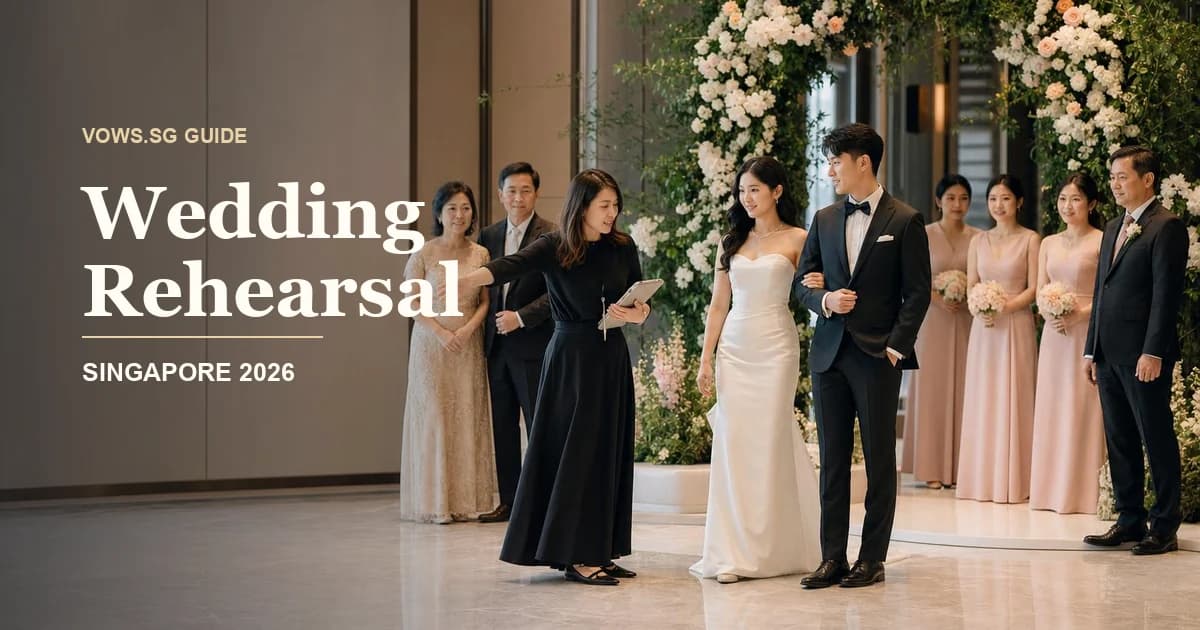
A wedding rehearsal is not about making everyone perform perfectly. It is about removing the small uncertainties that cause stress on the actual day: who walks when, where parents stand, who carries the rings, which song starts at which cue, where the tea cups go, and who takes over when the couple is busy smiling for photos.
In Singapore, this matters even more because many weddings combine several moving parts in one day: morning gatecrash, tea ceremony, ROM solemnisation, church or hotel ceremony, banquet march-in, table photos, outfit changes, elderly relatives, dialect customs, and sometimes wet-weather backup plans. A good rehearsal keeps the day feeling warm and natural, not stiff.
The best rehearsal is practical, short, and led by one clear person. You do not need to rehearse every hug and handshake. You do need everyone to know where to stand, when to move, and who to look at when something changes.
When to Hold Your Wedding Rehearsal
For most Singapore weddings, hold the main rehearsal one to seven days before the wedding. The exact timing depends on your venue and ceremony format.
If you are having a hotel or restaurant banquet with a ROM solemnisation before dinner, ask the venue whether they allow rehearsal during setup hours. Many couples do a quick walkthrough in the late afternoon or evening before the wedding, but this depends on ballroom availability. If another event is using the room, your rehearsal may need to happen in a function room, foyer, or during your final coordination meeting instead.
For church weddings, rehearsals are often held the evening before, especially if there is an aisle procession, readings, music team, communion, or specific church protocol. Check with the church office early because rehearsal slots may be limited.
For home tea ceremonies, especially in HDB flats, BTO units, parents’ homes, or compact living rooms, you may not need a formal rehearsal. But you should still do a movement check: where the couple kneels or sits, where parents sit, where the tea set is placed, where relatives queue, and how the photographer can move without blocking elderly family members.
| Wedding Format | Best Rehearsal Timing | What to Rehearse |
|---|---|---|
| ROM solemnisation at hotel before banquet | 1 to 3 days before, or same-day before guests arrive | Processional, vows, signing table, rings, recessional, photo positions |
| Church wedding | Usually the day before | Full aisle order, music, readings, family seating, couple positions |
| Restaurant banquet only | Final venue meeting or same-day setup check | March-in route, music cues, champagne pour, yum seng, table photo route |
| Home tea ceremony | 1 to 2 weeks before as a family walkthrough | Seating, tea order, ang bao tray, movement through rooms |
| Outdoor solemnisation | 1 to 3 days before, plus same-day weather call | Wet-weather switch, sound check, guest movement |
| Lunch banquet | Earlier in the week or very early on wedding day | Tight timing, vendor arrival, family photo sequence |
A rehearsal should usually take 45 to 90 minutes. If it goes beyond two hours, it usually means the run sheet is unclear or too many people are debating details on the spot.
Who Must Attend
Keep the rehearsal group tight. The more people you invite, the more opinions you collect.
The essential people are:
- The couple
- Solemniser, pastor, priest, or ceremony lead, if available
- Both sets of parents
- Bridal party or siblings involved in procession
- Emcee
- Wedding coordinator or banquet manager
- Photographer and videographer, if they need movement cues
- Music or AV person
- Ring bearer, flower child, or page boy/girl, if they are part of the ceremony
- Tea ceremony helper, usually a sibling, cousin, auntie, or bridesmaid
Not every guest needs to attend. Your uncles and aunties do not need to rehearse table photos. They just need clear instructions on the day.
For parents, attendance is important because many Singapore wedding moments are family-led. Parents often decide how certain relatives should be seated, which dialect order to follow for tea ceremony, whether grandparents receive tea before parents, and how formal the ROM or march-in should feel. Settle these points before the wedding day, not while everyone is hungry and the banquet manager is chasing the next cue.
If parents are not free for the full rehearsal, ask them to join the first 20 minutes for:
- Processional or family entrance
- Seating positions
- Tea ceremony order
- Family photo grouping
- Any dialect or custom expectations
For flower children, rehearse once, then let it go. Children may forget everything on the actual day, and that is fine. Assign one adult they trust to walk them to the aisle or receive them at the front.
Build One Run Sheet Before You Rehearse
Do not start the rehearsal by asking, “So how ah?” That is how one simple walkthrough becomes a family meeting.
Prepare a run sheet before everyone arrives. It does not need to be fancy, but it must show:
- Time
- Location
- Cue
- Person responsible
- Backup option
- Notes for vendors
Use one master version only. Couples often get into trouble when the hotel, emcee, bridesmaids, and photographer each have slightly different timelines.
A simple format works best:
| Time | Segment | Cue | Owner | Notes |
|---|---|---|---|---|
| 5:00pm | Solemnisation setup | AV test and signing table ready | Venue coordinator | Check microphones, pens, chairs |
| 5:20pm | Family seated | Parents and grandparents seated | Usher lead | Reserve aisle seats |
| 5:30pm | Processional | Music starts when doors open | Emcee / AV | Bride enters after parents stand |
| 5:45pm | ROM signing | Couple and witnesses move to table | Solemniser | Rings and ICs ready |
| 6:00pm | Group photos | Immediate family first | Photographer | Keep grandparents seated nearby |
| 7:30pm | First march-in | Lights dim, doors open | Banquet manager | Emcee intro before music |
| 8:15pm | Second march-in | Couple enters in second outfit | Coordinator | Champagne tower after stage cue |
Print or share the run sheet with only the people who need it. Too many versions floating around in WhatsApp groups will create noise.
For a full planning structure, you can pair this rehearsal run sheet with a broader Singapore wedding planning checklist.
ROM Solemnisation Flow
A Singapore ROM solemnisation is usually simple, but it still needs cues. The ceremony may be short, but the movement around it can get messy if nobody knows where to sit or stand.
A typical hotel or restaurant solemnisation flow looks like this:
- Guests arrive and are seated
- Parents and grandparents are guided to reserved seats
- Emcee or coordinator asks guests to settle
- Processional music starts
- Groom enters or waits at the front
- Bride enters with father, mother, both parents, or alone
- Couple stands before solemniser
- Solemniser gives opening remarks
- Couple exchanges vows or declaration
- Rings are exchanged
- Couple, witnesses, and solemniser sign documents
- Couple is pronounced married
- Recessional music plays
- Family photos begin
Rehearse the positions, not the whole speech. The solemniser will guide the legal words.
Key decisions to settle:
- Who walks the bride in?
- Does the groom enter first, or wait at the front?
- Where do parents sit?
- Who holds the rings?
- Where are the NRICs or documents kept?
- Who moves chairs away after signing, if needed?
- Where does the couple stand for photos after the ceremony?
Do not place the signing table too far from the ceremony position. If it is across the room, the couple, witnesses, photographer, and solemniser all have to move at once, which breaks the flow. A nearby side table usually works better.
If the solemnisation is outdoors, test the microphone. Singapore outdoor spaces can be noisy: wind, hotel water features, traffic, nearby diners, or aircraft depending on location. The couple may think they can “just speak louder”, but guests behind cannot hear vows clearly without proper sound.
March-In and Music Cues
The march-in is one of the most visible moments of the banquet, but it often fails for boring reasons: the wrong song version, doors opening too early, AV not knowing the cue, or the couple walking too fast.
Rehearse the march-in with the actual route if the venue allows it. Check:
- Which door opens
- Where the couple waits
- Whether there are steps, carpet edges, cables, or tight turns
- Where the photographer and videographer stand
- When the music starts
- When lights dim
- Whether confetti, bubbles, dry ice, or cold sparks are allowed
- Where the couple stops before going on stage
For music, send the venue the exact file or streaming instruction early. Do not rely on “the song from YouTube” unless the AV team confirms it. If you have a specific chorus entry, trim the audio file or give a clear timestamp. A 15-second delay feels very long when the ballroom doors are already open.
Common Singapore banquet music cues include:
- Pre-banquet background music
- Solemnisation processional
- Solemnisation recessional
- First march-in
- Cake cutting or champagne pour
- Yum seng cue
- Second march-in
- Couple speech
- Same-day-edit video audio
- Table photo background music
If your banquet includes a live band, ask who controls the final cue: the emcee, band leader, banquet manager, or coordinator. One person must own the signal. Too many people pointing across the ballroom is not a system.
Tea Ceremony Movement
Tea ceremony is where Singapore weddings can become emotionally beautiful or logistically chaotic. The ceremony may happen at the bride’s home, groom’s home, hotel suite, restaurant private room, or a function room before the banquet.
If you are doing traditional customs, align the tea ceremony with your family’s expectations after Guo Da Li. Our Guo Da Li guide covers the broader gift exchange, while the Chinese tea ceremony guide goes deeper into order, greetings, and etiquette.
For rehearsal, focus on movement:
- Where the couple sits, kneels, or stands
- Where parents and elders sit
- Where the tea tray starts
- Who pours or refills tea
- Who collects ang baos or jewellery
- Where received gifts are placed
- How relatives queue without blocking the photographer
- Whether shoes are removed at home
- Where elderly relatives can rest
In a HDB or BTO flat, space matters. Avoid placing the tea ceremony right in the narrowest part of the living room. Keep one clear lane for relatives and one lane for vendors. If the photographer has to squeeze behind the sofa every round, everything slows down.
For dialect families, ask parents about order early. Some families prioritise paternal relatives, some start with grandparents, some include specific greetings, and some are relaxed as long as elders are respected. There is no need to over-theorise it; just agree on the order and write it down.
A simple tea ceremony order may look like:
- Groom’s grandparents
- Groom’s parents
- Groom’s elder uncles and aunties
- Groom’s elder siblings and cousins, if applicable
- Bride’s grandparents
- Bride’s parents
- Bride’s elder relatives
- Younger siblings or cousins serve tea to the couple, if your family practises this
Keep ang baos and jewellery organised. Assign one trusted person to hold a labelled pouch or tray. Si Dian Jin, jewellery, and heirloom pieces should not be left on random side tables. If your family is preparing jewellery gifts, this Si Dian Jin guide may help with expectations.
Banquet Handoffs
Banquet flow depends on handoffs. The couple will not be free to manage the room once guests arrive, so each transition needs an owner.
Important handoffs include:
- Coordinator to banquet manager: final guest count, VIP tables, dietary notes
- Coordinator to emcee: updated script, pronunciation, table sequence
- Couple to photographer: must-have family photo list
- Bridal party to coordinator: rings, vows, outfit items, emergency kit
- Parents to coordinator: relatives who must be greeted or photographed
- Venue to AV: videos, music, mic checks
- Hotel room helper to couple: second outfit, shoes, accessories, touch-up kit
Ask the banquet manager for the venue’s usual timeline. Hotels and restaurants often have a rhythm: cocktail starts, doors open, first dish timing, march-in, course pacing, second march-in, champagne, speeches, table photos, dessert, farewell line. Work with that rhythm rather than fighting it.
For lunch banquets, timing is tighter. Makeup starts early, tea ceremony may be compressed, and guests arrive before everyone is mentally ready. For dinner banquets, the risk is delay: tea ceremony overruns, traffic builds, elders arrive early, or the solemnisation starts late. Build buffers.
GST and service charge also matter for planning extras. If you add late-night snacks, extra AV support, extension hours, or additional tables, check whether prices are quoted before GST and service charge. For broader budgeting, see our Wedding Cost Singapore 2026 guide.
Family Seating and VIP Tables
Seating is not just admin. It is politics, comfort, and respect wrapped into one floor plan.
Start with the VIP tables:
- Couple’s immediate family
- Grandparents
- Siblings and partners
- Closest relatives
- Solemniser, pastor, or key elder, if invited to dine
- Important family friends, if parents request it
Ask both sets of parents to review the VIP tables before the final deadline. Do not guess which uncle must sit near which auntie. Parents usually know the family dynamics better.
For elderly guests, prioritise:
- Short walking distance from entrance
- Easy access to toilets
- Lower speaker volume
- Clear view of stage
- Space for walking aids or wheelchairs
- No awkward squeezing near service stations
For friends, consider MRT and travel logistics too. If the venue is not near an MRT station, mention parking, shuttle bus, or drop-off instructions in the invite or wedding website. This is especially helpful for guests moving from work to a weekday dinner banquet.
During rehearsal, check the actual ballroom layout. Floor plans can look spacious on PDF, then feel tight once photo booth, reception table, stage, aisle decor, and extra tables are added. If you are doing table photos, plan the route so the couple is not zig-zagging across the ballroom after every dish.
Wet-Weather Backup
Singapore weather is not dramatic; it is just very committed to being unpredictable. If any part of your wedding is outdoors, decide the wet-weather plan before the rehearsal.
This applies to:
- Garden solemnisation
- Poolside ceremony
- Beach or seaside shoot
- Outdoor cocktail reception
- Open-air tea ceremony
- March-in from an outdoor area
- Photo session between home and venue
Ask the venue:
- What time is the weather call made?
- Who makes the final decision?
- Where is the indoor backup?
- Will chairs, flowers, and signing table be moved?
- Is there enough shelter for elderly guests?
- Does the indoor setup change the aisle route?
- Will sound equipment still work outdoors?
- Are umbrellas provided, or should you prepare your own?
Do not make wet-weather decisions based on vibes. If the backup is ugly but functional, decide whether you prefer comfort or photos. For elderly guests and ROM documents, comfort usually wins.
If you are moving between HDB blocks, parents’ homes, hotels, and photo locations, build travel buffer. Rain slows everything down: Grab availability, carpark queues, dress handling, makeup touch-ups, and unloading props. A 15-minute buffer is not generous in heavy rain; it is the minimum.
Common Rehearsal Mistakes to Avoid
Most rehearsal problems are avoidable. Watch for these:
- Rehearsing without a run sheet
- Letting too many relatives redesign the programme
- Forgetting to test microphones
- Using the wrong song version
- Not deciding who holds rings and documents
- Ignoring elderly guest movement
- Assuming the hotel will cue everything automatically
- Forgetting that the couple cannot manage logistics once dressed and photographed
- Not sharing family photo groupings with the photographer
- Treating tea ceremony order as “settle on the day”
- Planning outdoor solemnisation without a real indoor backup
- Forgetting vendor meals, parking, loading bay access, or service lift timing
The biggest mistake is having no single coordinator. This does not always mean hiring a full wedding planner. It can be a day-of coordinator, a trusted friend, or a capable sibling. But it cannot be the bride, groom, or either set of parents. They are too involved emotionally and socially.
A day-of coordinator in Singapore can vary widely in cost depending on scope, experience, and hours. As a stable planning range, many couples budget around S$800 to S$2,000+ for coordination support, with higher costs for full planning, complex multi-location days, or larger weddings. Smaller weddings may rely on a venue coordinator plus one strong friend, but be honest about the workload.
Other rehearsal-related costs may include:
- Printing run sheets and seating plans: about S$20 to S$80
- Extra transport buffer for helpers or family: about S$50 to S$200+
- Additional AV support or technician time: varies by venue, often charged separately
- Venue overtime or room extension: check package terms before assuming it is included
- Umbrellas, fans, bottled water, or simple elder-care items: small cost, big comfort
Practical Coordinator Checklist
Use this as the final rehearsal and wedding-day checklist. Assign names, not just tasks.
Before Rehearsal
- Confirm rehearsal date, time, and venue access
- Prepare one master run sheet
- Prepare ceremony seating plan
- Prepare banquet seating plan and VIP table list
- Confirm tea ceremony order with both families
- Confirm march-in route with venue
- Send music files or links to AV team
- Prepare vows, rings, NRICs, and signing items
- Share family photo list with photographer
- Confirm wet-weather backup and decision time
- Confirm vendor arrival times, loading bay, and parking
- Confirm any dietary needs for VIPs and elderly guests
- Check whether added costs include GST and service charge
During Rehearsal
- Walk through ROM processional and recessional
- Mark where the couple, parents, witnesses, and solemniser stand
- Test microphones and music cues
- Practise door opening and march-in timing
- Walk the tea ceremony movement if space is tight
- Confirm where ang baos, jewellery, and tea set will be placed
- Check stage access, stairs, cables, and gown movement
- Confirm emcee cues for march-in, videos, champagne, speeches, and yum seng
- Check family seating and elderly access
- Confirm who handles last-minute guest changes
- Confirm who makes the wet-weather call
- Keep the rehearsal short and stop side debates early
On the Wedding Day
- Keep rings, vows, NRICs, and documents with the assigned person
- Check that parents and grandparents are seated before ceremony starts
- Cue music only when the couple is ready
- Keep the aisle clear for photographer and videographer
- Move elderly relatives first after ceremony or tea ceremony
- Collect ang baos and jewellery into a secure labelled bag
- Update banquet manager on final attendance changes
- Remind emcee of any name pronunciation notes
- Keep the couple hydrated and fed where possible
- Protect buffer time before march-in
- Switch to wet-weather plan early if needed
- Handle small problems quietly instead of pulling the couple into every decision
A good Singapore wedding rehearsal is not about perfection. It is about making the day feel steady enough for everyone to enjoy it. When parents know where to sit, helpers know what to carry, vendors know their cues, and the couple knows they do not have to manage every detail, the whole wedding feels lighter.
Related Guides
The tool for this step
Compare Wedding Venues & Packages
133 venues, 1,008 packages — filter by budget, region, and capacity
Planning your own wedding? Get every step like this one in a free personalised checklist.
Start planning freeRelated Guides
ROM Singapore Guide 2026/2027: Process, Fees & Tips
How to ROM in Singapore (2026/2027): the 21-day notice window, S$42 fee, documents to prepare, choosing a solemnizer, and booking your ceremony at Esplanade Mall or the Ficus Room at Gardens by the Bay.
Wedding Planning in Singapore: 12-Month Checklist (2026/2027)
Wedding planning in Singapore, month by month: what to book when, ROM and HDB timing, cultural ceremonies, and a free checklist built around your date.
ROM vs Wedding Ceremony in Singapore: Do You Need Both? (2026/2027)
ROM vs wedding ceremony — what's the legal difference, do you need both? Clear costs breakdown for Singapore couples planning their big day in 2026