Wedding First Dance Singapore 2026: Lessons & Tips
Plan a 2–3 minute Singapore wedding first dance with lesson timelines, choreography, song and floor choices, dress practice, nerves, and realistic costs.
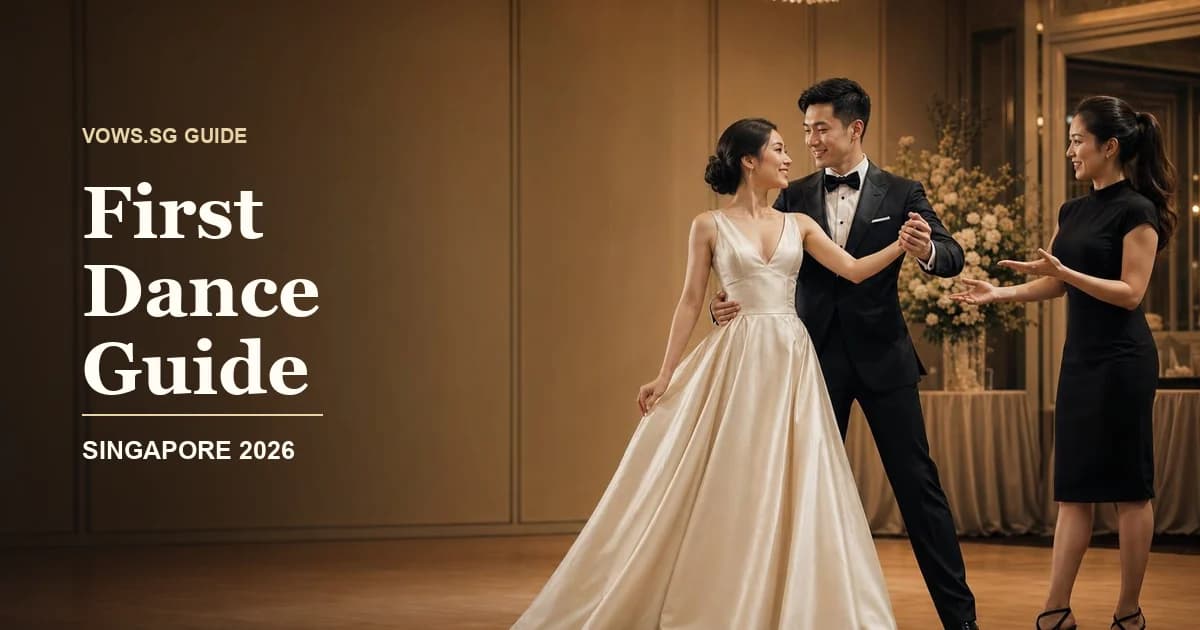
Your first dance does not need to look like a competition routine. It needs to feel comfortable, fit the venue and give your photographer a clean moment to capture.
For Singapore couples, the practical challenge is often not learning the steps. It is fitting lessons around work, BTO appointments, Guo Da Li preparations, gown fittings, ROM arrangements and family expectations—then performing on a ballroom floor you may only see properly during the final rehearsal.
The best approach is to decide early what kind of moment you want: a relaxed sway, a polished short routine or a full choreographed performance. From there, you can choose the right lesson format, song length and practice schedule without turning the dance into another source of wedding stress.
Decide What You Want the First Dance to Achieve
Before booking lessons, agree on the mood rather than the dance style.
Ask each other:
- Do we want a romantic moment or an entertaining performance?
- Are we comfortable being watched?
- Do we want lifts, dips or recognisable choreography?
- Will the dance happen before dinner, between courses or near the end of the banquet?
- Do we want guests to watch the whole dance, or join us halfway?
- Is either partner wearing restrictive clothing or uncomfortable shoes?
A simple first dance can still look polished when the couple has good posture, a clear entrance and a confident ending. Conversely, an elaborate routine can feel awkward if it is too long, too difficult or squeezed into a small hotel ballroom.
If one partner wants choreography and the other prefers a sway, choose a middle ground: begin with an easy hold, add one or two turns, then finish with a gentle dip or embrace. You will have enough movement for photos without memorising dozens of counts.
Private vs Group Wedding Dance Lessons
Group and private lessons serve different purposes. The right choice depends on your confidence, schedule and whether you want choreography built around a particular song.
| Lesson format | Best for | Main advantage | Tradeoff |
|---|---|---|---|
| Group classes | Couples exploring ballroom basics | Lower-pressure introduction to steps and rhythm | Class content may not match your song or timeline |
| Private lessons | Couples preparing for a specific first dance | Personalised coaching and faster correction | Higher overall budget |
| Semi-private lessons | Friends or two wedding couples learning together | More attention than a large group at a shared cost | Scheduling several people can be difficult |
| One-off coaching session | Couples planning a simple sway | Helps with posture, turns, entrance and ending | Limited time to build muscle memory |
| Full choreography package | Couples wanting a performance | Routine can be adapted to the song, venue and outfits | Requires more lessons and home practice |
Choose group lessons if you are still exploring
A beginner group class is useful when you have several months and are not sure whether you prefer waltz, rumba or a simple social-dance style. It can also make lessons feel less intimidating because everyone is learning together.
However, group lessons usually follow a set syllabus. You may learn useful foundations without finishing a wedding-ready routine. Ask whether the instructor can later offer a private session to adapt those foundations to your chosen song.
Choose private lessons for efficiency
Private lessons are usually the better fit when:
- Your wedding is less than three months away.
- You have already selected the song.
- One partner has significantly more dance experience.
- You need steps adapted to a gown, train or limited floor space.
- Your work or travel schedule makes regular group classes difficult.
- You want a personalised edit and clear DJ cues.
Couples living or working at opposite ends of Singapore should also consider logistics. A studio near an MRT interchange or one partner’s workplace may be easier to sustain than a cheaper class requiring several transfers. Consistent attendance matters more than saving a little on each lesson.
How Early Should You Start?
For most couples, three to four months before the wedding is a comfortable starting point. This provides enough time to learn gradually without letting practice drag across the entire planning year.
A practical timeline is:
Six months or more before
Explore dance styles, shortlist songs and try a beginner class if both of you are unsure. There is no need to lock in detailed choreography yet, especially if the gown and venue layout are undecided.
Three to four months before
Book lessons and select the main song. Tell the instructor about the venue, outfit and desired level of difficulty. Aim to learn the structure of the routine during this period.
Six to eight weeks before
Confirm the edited track and practise regularly. By now, you should know the entrance, main sequence and ending. Avoid adding major new sections unless the routine is genuinely too simple for your preference.
Two to four weeks before
Practise in wedding shoes and clothing with similar movement restrictions. Confirm the ballroom floor dimensions, DJ cue, lighting plan and photography positions.
Wedding week
Run the routine once or twice in a suitable space, then stop making changes. The goal is calm familiarity, not last-minute perfection.
If your wedding planning calendar is already crowded with vendor payments, fittings and family arrangements, map these tasks using a Singapore wedding planning checklist. Couples holding a tea ceremony and banquet on the same day should be particularly realistic about their energy levels.
Simple Sway or Full Choreography?
There is no rule that says a first dance must involve formal ballroom steps.
A simple sway works well when
- One or both partners are shy.
- The wedding schedule is packed.
- The bride’s gown has a long or heavy train.
- The dance floor is small.
- You have limited practice time.
- You want the moment to feel intimate rather than performative.
A polished sway can include a slow entrance, natural weight changes, one underarm turn and a final pose. These details create movement for the camera without making the couple look as though they are counting steps.
Choreography works well when
- Both partners enjoy performing.
- The song has clear changes in tempo.
- You have enough practice time.
- The venue provides a suitable dance area.
- Your outfits allow safe movement.
- You are happy to repeat the routine until it feels natural.
Keep the difficulty slightly below what you can manage in the studio. Wedding-day conditions are different: there may be a slippery floor, warm lighting, nerves, a fitted gown and guests standing close to the performance area.
Avoid lifts unless they have been taught properly and tested in the actual shoes and outfit restrictions. A clean turn or controlled dip is usually safer and photographs just as well.
Keep the Song Short
A song may feel brief when you listen to it casually, but three or four minutes can feel very long when the whole ballroom is watching.
For many weddings, about 90 seconds to two minutes is enough. This gives you time for:
- A clear entrance.
- A romantic opening.
- One or two memorable movements.
- A confident ending.
You do not need to use the full studio recording. Ask your instructor, DJ or bandleader whether the track should be trimmed, faded or rearranged. Use one final audio file across rehearsals and the wedding itself so there are no surprises.
Label the file clearly with your names and the words “final first dance edit”. Send it through the channel requested by your venue or entertainment vendor, and keep a backup copy on at least one phone.
If you prefer not to dance alone for long, invite parents, the bridal party or all guests onto the floor after the first minute. Agree on the exact musical cue so your emcee knows when to make the invitation.
Check the Ballroom Floor Before Finalising Steps
Ask the venue coordinator for the clear usable dance area, not merely the size of the ballroom. Staging, banquet tables, floral installations, speakers and the wedding aisle can reduce the available space considerably.
As a planning guide:
- Around 3m by 3m can suit a stationary sway with small turns.
- Around 4m by 4m gives a couple more room for travelling steps.
- Around 5m by 5m or larger is more comfortable for wider choreography.
These are practical planning dimensions, not venue rules. Pillars, steps and table placement can make an otherwise large area difficult to use.
Send the instructor a floor plan, walkthrough video or photo taken from the ballroom entrance. Check whether the floor is timber, carpeted, tiled or covered with a temporary dance surface. Practising large travelling patterns in a studio will not help if the actual venue only has space for two small turns.
For restaurant weddings, confirm whether tables must be shifted before the dance and how long this takes. At hotels, ask whether the dance happens on the main floor, stage or aisle. Timing matters because banquet teams may be preparing the next course while you perform.
Plan Around the Gown Train and Shoes
Your instructor should know the gown silhouette before completing the choreography.
A fitted mermaid gown may restrict stride length. A ball gown can hide footwork but occupy more space. A long train can catch under either partner’s shoes during backward steps and turns.
Discuss these options with the bridal boutique:
- Bustling or hooking up the train before the dance.
- Changing into a reception gown.
- Removing or shortening a detachable overskirt.
- Wearing dance-friendly shoes during the banquet.
- Practising in a petticoat or skirt with similar volume.
Bring your wedding shoes—or a pair with the same heel height—to later lessons. Grooms should also practise in dress shoes rather than trainers, especially if the soles feel different.
Do not wait until the final fitting to discover that the gown prevents a planned dip. Record a short practice video in the fitting room if the boutique permits it, then show the instructor how the dress moves.
Give the DJ, Emcee and Venue Clear Cues
Your first dance is a small production involving more people than the couple.
Prepare a simple cue sheet covering:
- The couple’s starting position.
- The emcee’s introduction.
- The exact song file and version.
- Whether music begins before or after you enter.
- The lighting change.
- The point when family or guests join.
- The final pose or music fade.
- What happens immediately afterwards.
If the dance is scheduled between banquet courses, confirm the timing with the banquet manager. You do not want service staff entering the floor during the final pose or guests being distracted by dishes arriving.
Also ask whether dry ice, moving lights or confetti will be used. Effects can look impressive, but heavy fog may hide your feet and make floor edges difficult to see. Flashing lights can also complicate photography.
Rehearse the Entrance and Ending
Couples often practise the middle repeatedly and forget the two moments guests notice most: how the dance starts and how it finishes.
During rehearsal, decide:
- Where each partner waits.
- Who walks onto the floor first.
- When you take your dance hold.
- What to do during any musical introduction.
- Which direction you face for the final pose.
- How you leave the floor.
If possible, do a short venue rehearsal after the stage and tables are set. Even a five-minute walkthrough helps you understand distances and camera positions. If ballroom access is unavailable, mark the floor dimensions using tape at home, in a condo function room or in a booked studio.
Avoid exhausting yourselves with a late-night rehearsal after the Guo Da Li, solemnisation setup or full-day tea ceremony preparations. The Guo Da Li guide and Chinese tea ceremony guide can help you plan those traditions without letting them collide with dance practice.
Coordinate Camera Angles
Tell your photographer and videographer what the main movements are. A quick rehearsal video is often more useful than a written description.
Point out:
- The direction of the first turn.
- Any dip or lift.
- Your final pose.
- Whether parents will join.
- Where guests may crowd around the floor.
Try to face the main camera for the final movement rather than ending with one partner’s back blocking the other. If you have a prominent stage backdrop or floral installation, discuss whether it should appear behind you in wide shots.
Ask the photo and video teams to coordinate positions so neither walks directly into the other’s frame. Guests holding phones are harder to control, but the emcee can politely ask everyone to remain behind the designated floor boundary.
First-Dance Tips for Shy Couples
You do not have to become an extrovert for the evening.
To make the experience easier:
- Keep the private portion under two minutes.
- Look at each other rather than scanning the room.
- Choose movements that let you stay physically connected.
- Avoid choreography built around solo sections.
- Practise recovering from a missed step.
- Invite family or friends to join after the first chorus.
- Choose a familiar song that makes you feel relaxed.
If something goes wrong, keep swaying. Guests do not know the choreography, so they are unlikely to notice a skipped turn unless you stop and react.
A private lesson can also be less stressful than learning in front of a group. Tell the instructor honestly that confidence—not technical complexity—is the priority.
Include Family Dances Thoughtfully
Some couples follow the first dance with a father-daughter, mother-son or family dance. This can be meaningful, but it should not be assumed.
Ask parents privately whether they are comfortable participating. Some may be shy, have mobility concerns or feel uncertain about expectations. Dialect-speaking grandparents may also need the sequence explained directly rather than through a fast emcee announcement.
Alternatives include:
- Inviting both sets of parents onto the floor together.
- Beginning with the couple before opening the dance to family.
- Dedicating a song without requiring a formal dance.
- Walking to each table to greet older relatives.
- Holding the family moment after the tea ceremony instead.
Keep family dances short if the banquet schedule is tight. Three full songs can delay food service and leave guests wondering when they should join.
Set a Realistic Dance Budget
Lesson costs vary by instructor experience, studio rental, class size, number of sessions and degree of customisation. Instead of relying on one advertised figure, set a planning allowance and request itemised quotations.
| Approach | Suggested planning allowance | Likely inclusions |
|---|---|---|
| DIY sway | S$0–S$100 | Home practice, song editing tools or studio rental |
| Group-class foundation | S$100–S$400 per couple | Several shared classes, usually without full custom choreography |
| Short private lesson block | S$300–S$800 per couple | Basic personalised routine and technique coaching |
| Tailored choreography programme | S$800–S$1,800+ per couple | Multiple private sessions, song structure and detailed routine work |
| Extras | Allow S$50–S$300+ | Studio hire, music editing, extra rehearsal or last-minute coaching |
These are budgeting ranges rather than fixed 2026 vendor prices. Confirm whether quotations include GST, studio rental, music editing, rehearsal space and rescheduling fees. Ask how long each lesson lasts and whether unused sessions expire.
Include dance lessons within your wider Singapore wedding cost plan. They should not come at the expense of essential items or push you into relying on ang bao collections to settle invoices after the banquet.
Wedding First Dance Checklist
Three to four months before
- Agree on a sway, simple routine or full choreography.
- Choose private, group or semi-private lessons.
- Shortlist a song and discuss the desired mood.
- Ask the venue for the usable floor dimensions.
- Tell the instructor about the gown and shoes.
- Set a budget, including GST and possible studio rental.
Six to eight weeks before
- Finalise the routine and edited song.
- Send the instructor the venue floor plan or walkthrough video.
- Practise at least once a week outside lessons.
- Decide whether parents or guests will join.
- Share important movements with the photographer and videographer.
- Confirm whether the train will be bustled or removed.
Two to four weeks before
- Practise in shoes with the correct heel height.
- Test the routine in an outfit with similar movement restrictions.
- Prepare the DJ and emcee cue sheet.
- Confirm lighting, dry ice and special effects.
- Check where the dance fits within hotel or restaurant service.
- Save backup copies of the final audio file.
On the wedding day
- Clear the dance floor of bags, cables and décor.
- Check that the correct song file is loaded.
- Brief the emcee, DJ, banquet manager and photo team.
- Walk through the entrance and ending once.
- Keep your steps smaller if the floor feels slippery.
- Look at each other, breathe and keep moving—even if you miss a step.
Related Guides
The tool for this step
Compare Wedding Venues & Packages
133 venues, 1,008 packages — filter by budget, region, and capacity
Planning your own wedding? Get every step like this one in a free personalised checklist.
Start planning freeRelated Guides
Wedding Photo Booth Singapore 2026
Choose a Singapore wedding photo booth with instant prints, roving photography, GIFs, backdrops, props, guestbooks, and package tips.
Wedding After-Party Singapore 2026
Plan a Singapore wedding after-party with venue types, guest list, timing, music, transport, minimum spend, and recovery-friendly logistics.
Wedding Dietary Requirements Singapore 2027
Manage 7 Singapore wedding dietary needs—from halal and vegetarian meals to allergies—with RSVP wording, kitchen checks, labels, seating and venue handoff.