Wedding Dietary Requirements Singapore 2027
Manage 7 Singapore wedding dietary needs—from halal and vegetarian meals to allergies—with RSVP wording, kitchen checks, labels, seating and venue handoff.
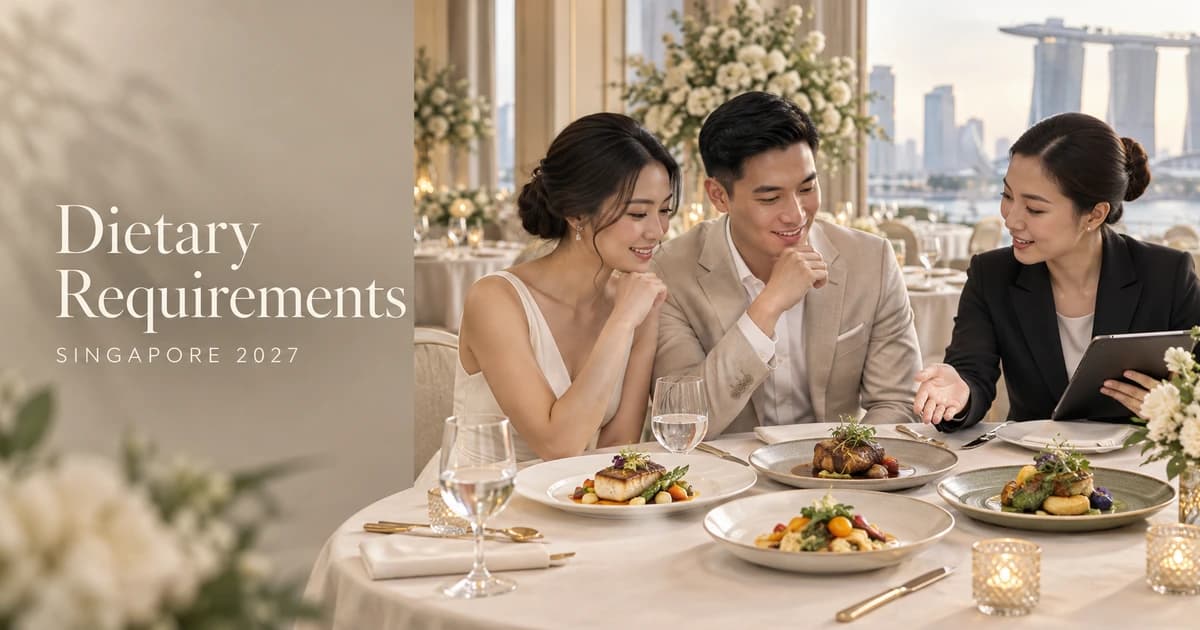
Start with the guest, not the menu label
One auntie avoids beef, your colleague needs halal food, and a friend has a serious shellfish allergy. All three need a proper meal. They do not necessarily need the same meal, and a spreadsheet column marked “special” will not tell the kitchen enough.
For a Singapore wedding, the useful question is: what can this particular guest eat, and what can this kitchen reliably provide? Ask early, keep the details private, and connect the answer to a named person and seat. A thoughtful menu matters more than making everyone appear to eat identical dishes.
This guide is for couples planning in 2027, using official guidance checked on 19 September 2026. It is not a promise of any venue's 2027 menus, certification, prices or ability to manage allergens. Confirm those for your actual event. Our wedding banquet and catering guide helps with the wider package comparison; here, the focus is getting individual meals right.
Seven dietary needs to clarify separately
These are conversation starters, not seven mutually exclusive boxes. A guest can need a halal meal without dairy, or a vegetarian meal without onion and garlic. Don't infer requirements from someone's name, ethnicity or religion.
| Need | Ask the guest | Ask the kitchen |
|---|---|---|
| Halal | What arrangements would you be comfortable with? | Which certified kitchen or supplier prepares this meal, and what does its certification cover? |
| Vegetarian | Do you eat eggs and dairy? | Are stocks, sauces, garnishes and desserts suitable too? |
| Vegan | Are there any additional ingredient restrictions? | Can every course exclude animal-derived ingredients, including hidden additions? |
| Buddhist-style or no-onion/no-garlic | Which ingredients do you personally avoid? | Can the chef follow that exact list rather than a generic vegetarian code? |
| No beef | Do you also avoid beef stock, sauces or other derivatives? | What goes into soups, gravies and prepared ingredients? |
| Gluten-related requirements | What food and preparation requirements should the chef know? | Can ingredients and cross-contact controls meet those requirements? |
| Food allergies | Which specific allergens must be avoided, and may the chef contact you privately? | Can you explain the ingredients, handling controls and any limits honestly? |
Vegetarian is not shorthand for vegan, halal or allergy-safe. “No beef” is not permission to serve any other meat. Buddhist food practices vary between families and individuals; let the guest specify their needs instead of turning a dialect or family tradition into a universal rule.
Gluten-related requests also need clarification rather than a diagnosis by the couple. Ask what the guest needs communicated, not for medical records. A request to avoid bread does not tell the chef enough about sauces or shared preparation equipment.
Verify halal arrangements beyond “no pork, no lard”
The MUIS consumer guidance explains that halal considerations include ingredients, preparation equipment and separation from non-halal substances. Removing pork alone does not establish halal status. Neither does an attractive “halal-friendly” phrase in a sales conversation establish certification.
Ask the coordinator to identify the actual preparation kitchen or supplier, share its certification details, and explain the meal's route to the guest. Don't assume that one certified outlet makes every restaurant, banquet kitchen or menu in a hotel certified. Check the relevant scope, address and validity, not just a logo on a proposal.
MUIS's digital certificate announcement explains how a certificate's QR code lets consumers check authenticity and current validity. A check today is not a guarantee for a wedding next year: recheck with the venue nearer the event.
If the venue proposes externally catered meals, ask who receives them, how they remain identified and appropriately handled, and who serves them. Share the concrete arrangement with the guest privately. Do not ask them to accept an ambiguous assurance to make the seating plan easier. A guest's comfort with an arrangement is not something the couple can decide on their behalf.
Ask about allergies without promising a safe plate
The Singapore Food Agency's allergy guidance advises checking dish ingredients and avoiding allergen cross-contact during preparation. It also notes that reactions can be life-threatening. A server picking prawns off a finished dish is not an adequate answer to a shellfish-allergy request.
Arrange a direct conversation between the guest and the venue's appropriate kitchen contact where possible. Keep the coordinator in the loop so the agreed preparation and service plan reaches the banquet team. Useful questions include:
- Can the chef check stocks, marinades, sauces, garnishes and bought-in ingredients, not only the main protein?
- How are utensils, preparation surfaces, cooking oil and serving equipment managed?
- Does a buffet or shared-platter service introduce handling risks the kitchen cannot control?
- Who checks the finished plate and confirms its destination before service?
- What will happen if ingredients change or the promised meal cannot be supplied?
Do not describe a meal as “allergen-free” simply because an ingredient is omitted. If the kitchen cannot meet the guest's requirements, tell the guest clearly and early. Discuss an alternative with them and the venue, including whether a separately supplied meal is permitted and how it would be stored, reheated and served. Bringing food from outside is not automatically a safe solution.
The SFA explanation of allergy and intolerance distinguishes the two. Neither should be dismissed as fussiness. Couples should not test a guest's tolerance, recommend medication or suggest “just a little” of an ingredient. Guests should follow their own clinician's advice and emergency plan; a severe reaction needs immediate medical attention, not a wait for the next course.
Put a clear, private question in the RSVP
Ask for each attendee's needs, including children, rather than accepting “two special meals” for a household. Our digital invitation and RSVP guide covers the broader response process. For this question, clarity beats an enormous dropdown of diet labels.
Suggested wording:
Please tell us about any food allergies or dietary requirements for each guest attending. List the specific ingredients to avoid and any preparation requirements. We will discuss these with the venue and confirm what it can provide. If you prefer, contact us privately instead of entering details here.
Add a short purpose statement: “We'll share the necessary meal information with the kitchen and relevant service staff to arrange your food.” Ask permission before passing on a guest's contact details for a chef follow-up. Collect only what is needed for meal planning, not a medical history or proof of religious observance.
Keep one access-restricted working list. Don't post allergy details in the family WhatsApp group, on a public wedding website or beside names on the public seating chart. Give the kitchen and serving team the information they need; the reception helpers may only need a discreet meal code and a contact for questions. Remove unnecessary copies after the event and final coordination are complete.
Price the actual arrangement, not a generic surcharge
Before signing, ask whether special meals replace a standard cover, sit outside the package, or require a separate order. Clarify any minimum quantity, menu-choice limits, tasting cost, delivery fee and external-food rules. These are contract questions, not uniform Singapore hotel policies.
A purely illustrative budget: eight replacement meals at an assumed S$25 extra each would add S$200 before any applicable charges. If those meals are charged as full additional covers instead, that calculation is wrong. This is arithmetic for comparing quotes, not a market rate or a vendor offer. Ask the venue to show the total payable, including any GST and service charge, and explain what happens to the original covers.
Parents may want a traditional shared banquet menu, while several relatives need individual portions. Ask for equally considered alternatives with a similar course rhythm, rather than an afterthought arriving during dessert. Put the agreed meal costs into your wedding budget, not into an assumed ang bao recovery figure.
Set your RSVP deadline backwards from the kitchen's actual amendment cut-off, leaving time for unanswered questions. Confirm the deadline in writing; do not copy another couple's “one week before” rule. Check separate meals for the tea ceremony, ROM reception or home gathering too. An evening banquet plan does not cover snacks served earlier in an HDB flat.
Hand over one version of the meal plan
Appoint one couple-side contact and one banquet contact. Your bridal party should not be passing three conflicting spreadsheets to different servers while the march-in starts. Use a version date and ask the venue to acknowledge the final list and outstanding exceptions.
For each relevant guest, record their name, table and seat, agreed requirements, confirmed meal, necessary handling notes and the staff contact responsible. A seat number alone is fragile when relatives switch places. Agree on a discreet identifier and have staff confirm the guest's name before placing the meal. A colour sticker can support that check; it cannot replace the underlying instructions.
Include all courses and drinks that need checking, not just the main. Share dessert, wedding cake and late-night snack arrangements with the responsible suppliers. A plated dinner agreement does not automatically cover a separate dessert table.
Reconfirm before the first plate leaves
Ask the banquet captain to brief the actual service team, including relief staff. If someone moves tables, the meal coordinator must update the kitchen and server before service. Never let an usher improvise by swapping two “special” plates because they look similar.
Build this handover into your wedding-day timeline, alongside the photographer briefing and reception setup. Recheck unresolved requests before the wedding, rather than leaving the guest to negotiate at the table. If an unexpected change cannot be verified, pause that guest's meal service and ask the responsible kitchen contact to resolve it with them.
Frequently Asked Questions
Can one vegetarian menu cover every special request?
No. It may include eggs, dairy, ingredients a particular guest avoids, or allergens. It also does not establish halal certification. Share the actual menu and preparation arrangements with each relevant guest and the kitchen. Combine orders only when the confirmed requirements genuinely match, not simply to reduce administration.
Is a hotel's “no pork, no lard” menu halal-certified?
That wording alone does not demonstrate certification. Ask which kitchen or supplier prepares the food and verify the applicable certificate and scope. Explain the arrangement to the guest without presenting your own inference as an official assurance. Recheck validity nearer the wedding, especially when booking for 2027.
Do we have to pay for a full extra table for dietary meals?
There is no single answer across venues and contracts. Ask whether the meals replace existing covers, require a minimum order, or are billed separately. Get the total cost and effect on the banquet minimum in writing before confirming. Do not assume special-meal guests disappear from the guaranteed headcount.
What if a guest tells us about an allergy after the deadline?
Contact the designated venue representative promptly and explain the specific requirement. Do not promise accommodation until the kitchen confirms what it can do. Keep the guest informed, discuss acceptable alternatives with them, and update the final service list. The deadline does not justify serving an unverified meal.
Should we print dietary requirements on place cards?
Avoid displaying private health or religious details to the whole table. Agree on discreet identifiers with the venue, supported by a restricted meal list and a name check at service. Make sure the staff understand each code and its handling instructions; a vague “V” or coloured dot is not enough on its own.
Your final dietary-meal checklist
- Ask every attendee individually, without assumptions based on family background.
- Confirm the exact ingredients and preparation needs, including overlapping requirements.
- Verify the relevant halal arrangement, scope and certificate validity where needed.
- Get the kitchen's written answer on allergen handling and any limitations.
- Agree on external-meal permissions and handling before relying on that option.
- Confirm cover replacement, minimum orders, surcharges and the total payable.
- Link each meal to a named guest and current seat, with discreet service identifiers.
- Restrict access to the meal list and obtain permission for direct contact sharing.
- Brief the actual service team and name the person who handles late changes.
- Recheck every food occasion, from the tea ceremony to the last snack, not just dinner.
The goal is not an impressive collection of menu labels. It is a guest who knows what has been arranged, a kitchen that understands the request, and a server who brings the right meal without making that guest explain everything again.
Related Guides
The tool for this step
Compare Wedding Venues & Packages
133 venues, 1,008 packages — filter by budget, region, and capacity
Planning your own wedding? Get every step like this one in a free personalised checklist.
Start planning freeRelated Guides
Digital Wedding Invitations & RSVP Singapore 2026
Choose a Singapore digital wedding invitation and track 6 RSVP essentials, including WhatsApp delivery, plus-ones, meals, privacy, and reminders.
Pet-Friendly Wedding Singapore 2027: Venue Checklist
Plan a pet-friendly Singapore wedding with 10 venue checks for indoor rules, handlers, heat, transport, allergies, ceremony roles and animal welfare.
The Ultimate Singapore Wedding Planning Checklist & Timeline (2026)
Wedding planning in Singapore, step by step: a 12-month checklist, budget and vendor priorities, plus a free personalised planner to put your plan into action.