Wedding Dowry Traditions Singapore 2026/2027
Understand Singapore wedding dowry traditions, Guo Da Li items, pin jin etiquette, return gifts, costs, and modern family expectations.
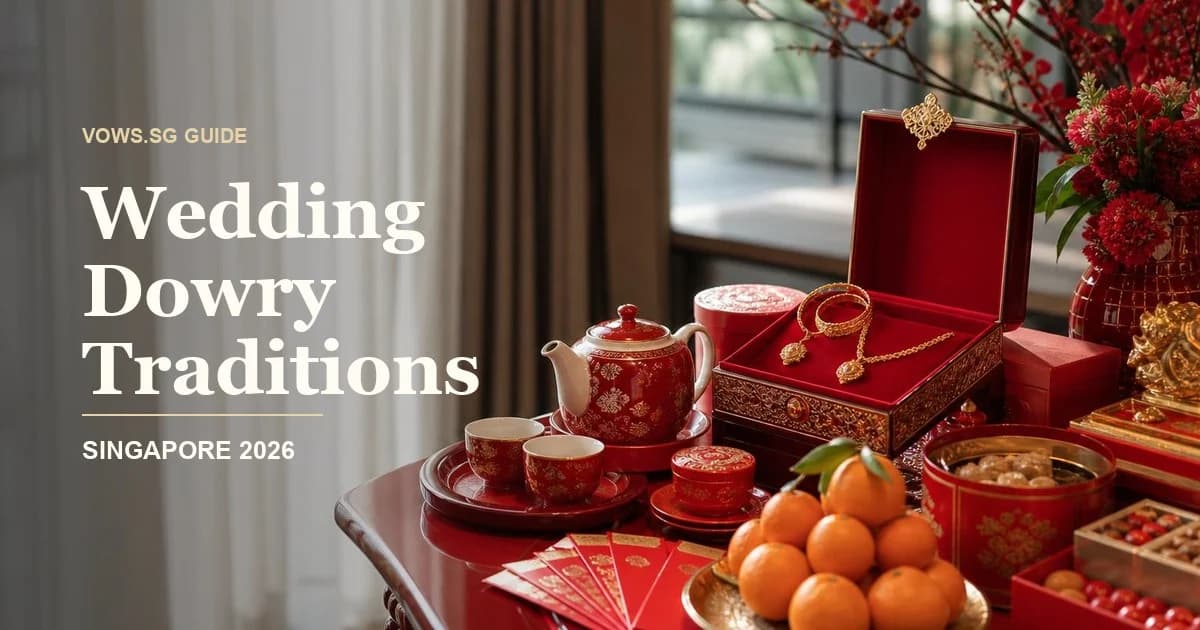
What “dowry” usually means in Singapore
In Singapore wedding talk, “dowry” can mean a few different things, so it helps to separate the pieces early. Most families are actually discussing a mix of:
- Pin jin: betrothal money from the groom’s family to the bride’s family.
- Guo Da Li: the formal gift exchange before the wedding.
- Hui li: return gifts from the bride’s family to the groom’s family.
- Bride’s dowry: items the bride’s family prepares for the couple, traditionally sent back with the return gifts.
- Si dian jin: four-piece jewellery set, often from the groom’s family, especially for Teochew families.
The tricky part is that many parents use these terms loosely. One family may say “dowry” and mean pin jin. Another may mean the bride’s household items. Another may include jewellery, cakes, canned pig trotters, dragon and phoenix candles, tea ceremony items, and ang bao all in one bucket.
So before anyone talks numbers, get the vocabulary aligned. It saves a lot of face.
For the broader ceremony flow, see the Guo Da Li guide and Chinese tea ceremony guide.
Pin jin is symbolic, but the number still matters
Pin jin is the red packet presented by the groom’s family to the bride’s family during Guo Da Li. Traditionally, it shows sincerity and respect. In modern Singapore, it is also one of the fastest ways for wedding planning to become awkward.
The amount can range widely. Some families choose symbolic figures such as $888, $1,888, $2,888, $3,888, $6,888, or $8,888. Some go higher, especially if the family is traditional, the banquet is large, or parents see pin jin as an important gesture of status. Other families prefer a modest amount and return most of it during hui li.
There is no universal “correct” amount in Singapore. The right number depends on:
- Family dialect group and strictness
- Whether the bride’s family expects to keep all, half, or a token portion
- Whether banquet tables are being covered separately
- Whether both sides are already helping with renovation, BTO, resale flat, or honeymoon costs
- Whether the couple is paying for most of the wedding themselves
- How much face both sets of parents attach to tradition
A useful modern approach is to treat pin jin as symbolic sincerity, not a transaction. If the amount starts feeling like a negotiation for the bride, something has gone off course.
How pin jin overlaps with Guo Da Li
Guo Da Li is the formal ceremony where the groom’s family brings gifts to the bride’s home. Pin jin is one of the items inside that exchange, usually placed in a red packet or gift box.
In Singapore, Guo Da Li is commonly held two to four weeks before the wedding, often on an auspicious date chosen by parents or a feng shui master. Some families keep it simple at home. Others rent or buy full gift sets, prepare pastries, arrange transport, and take photos.
A typical Guo Da Li exchange may include:
- Pin jin red packet
- Dragon and phoenix candles
- Wedding pastries or cake vouchers
- Oranges
- Tea ceremony items
- Jewellery or si dian jin
- Wine, liquor, or traditional gift items
- Dialect-specific items such as canned pig trotters, lamps, sewing kit, basin set, or baby prosperity items
The bride’s family then returns part of the gifts through hui li. This return is important because it shows acceptance of the marriage and goodwill between families.
If you are also planning the tea ceremony, avoid treating Guo Da Li as a standalone shopping errand. The items, guest expectations, jewellery, and parental roles often flow into the actual wedding day. For example, candles may be used later, jewellery may be worn during tea ceremony, and relatives may ask who gave what.
Hui li and return gifts
Hui li is the return-gift portion from the bride’s family to the groom’s family. Traditionally, the bride’s side returns part of the Guo Da Li gifts and sends the bride’s dowry items to the groom’s home.
Common return practices include:
- Returning a portion of the pin jin
- Returning part of the gift items
- Giving oranges back in even numbers
- Returning candles or paired items depending on dialect rules
- Preparing towels, bedsheets, tea sets, or household items
- Sending bride’s dowry items for the couple’s new home
Some families say “return half”. Some return only symbolic portions. Some keep the wine or specific items. Some modern families skip complicated item counting and agree on a clean package.
Do not assume both sides follow the same rule. Hokkien, Teochew, Cantonese, Hakka, and mixed-family expectations can differ, and many Singapore families now follow a hybrid version anyway.
A practical table by family strictness
Use this as a starting point, not a law. The point is to match the ceremony to your family reality instead of blindly buying things that nobody understands.
| Family style | Pin jin approach | Guo Da Li items | Return gifts | Best for |
|---|---|---|---|---|
| Minimal modern | Symbolic amount, often $888 to $2,888 | Red packet, oranges, simple pastries or vouchers | Token return, simple household item | Couples paying for BTO, renovation, ROM, and banquet themselves |
| Moderate traditional | $2,888 to $6,888, with agreed return portion | Standard gift set, candles, pastries, oranges, tea items, some dialect items | Return part of gifts, bride’s dowry items, oranges | Most Singapore couples balancing parent expectations with budget |
| Strict traditional | $6,888 and above, depending on family expectations | Full dialect-specific set, jewellery, cakes, liquor, candles, auspicious household items | Formal hui li with clear item counts and dowry delivery | Families where parents or grandparents strongly care about customs |
| Mixed-culture or interfaith | Symbolic or mutually agreed | Selected items that both families are comfortable with | Simple return gesture or family meal | Couples blending Chinese customs with Malay, Indian, Eurasian, Christian, Catholic, or secular traditions |
If either side is unsure, choose the moderate version and simplify from there. It is easier to remove unnecessary items than to patch hurt feelings after parents feel blindsided.
Who should discuss expectations?
The couple should start the conversation privately before parents enter the room.
Decide these points together:
- What budget range is realistic?
- Are you paying for the wedding yourselves?
- Is either family already contributing to banquet, house, renovation, or honeymoon?
- Do you want a full traditional Guo Da Li or a simplified one?
- Are there dialect customs that matter to grandparents?
- How much pin jin can be given without resentment?
- How much should be returned?
After that, each person should speak to their own parents first. This is usually less awkward than making parents negotiate directly from zero.
A good flow:
- Bride checks with her parents on expectations.
- Groom checks with his parents on comfort level.
- Couple compares notes privately.
- Couple proposes a middle ground.
- Parents meet only after the basic shape is settled.
The worst format is a first discussion over dinner where one parent casually asks, “So how much pin jin are you giving?” and everyone freezes over zi char.
How to avoid awkward money conversations
Money conversations become awkward when they feel like judgment. Parents may not only be thinking about money. They may be thinking about face, relatives, dialect tradition, whether their child is being respected, or whether the other family is “sincere”.
So frame the conversation around respect and practicality.
Try this wording:
- “We want to do this properly, but we also need to keep the wedding and home budget sensible.”
- “Can we understand which customs matter most to you, and which ones are flexible?”
- “Would you prefer a higher pin jin with more returned, or a smaller symbolic pin jin?”
- “We are also budgeting for GST, service charge, banquet deposits, renovation, and the honeymoon, so we want to avoid doing things for show only.”
- “Let’s agree early so nobody feels pai seh closer to the wedding.”
Avoid these:
- “This one outdated already.”
- “My friend only gave this amount.”
- “Your parents are asking too much.”
- “We are not paying for all this nonsense.”
- “Just tell them no.”
Even if you are right on budget, the wording can still burn the room. Use softer language with parents; be firmer behind closed doors as a couple.
What should go into the item list?
The item list depends on dialect, family strictness, and how much physical tradition you want to keep.
Simple modern list
Good for couples who want the gesture without turning the home into a storeroom.
- Pin jin red packet
- Two or more oranges
- Wedding pastries, cake vouchers, or small gift boxes
- Dragon and phoenix candles if parents want them
- Tea ceremony tea set if not already bought
- Return red packet or symbolic hui li items
Estimated budget excluding pin jin: around $100 to $300, depending on pastries and whether you buy a ready-made set.
Balanced Singapore list
This is the sweet spot for many families.
- Pin jin
- Guo Da Li basket or gift boxes
- Dragon and phoenix candles
- Oranges
- Wedding pastries or cake vouchers
- Liquor or wine if expected
- Tea ceremony items
- Jewellery or si dian jin if applicable
- Bride’s dowry items such as towels, bedsheets, lamps, basin set, or household goods
- Hui li return items
Estimated budget excluding pin jin and jewellery: around $300 to $800. Jewellery can change the total significantly, so discuss it separately. For more on jewellery expectations, read the si dian jin guide.
Strict traditional list
Use this when parents or grandparents care deeply about dialect customs.
- Full dialect-specific Guo Da Li set
- Pin jin in auspicious amount
- Si dian jin or agreed jewellery
- Dragon and phoenix candles
- Wedding pastries for relatives
- Liquor, wine, or traditional canned items
- Sewing kit, ruler, lamps, baby prosperity items, basin set, slippers, towels, bedsheets
- Exact return quantities for hui li
- Bride’s dowry delivery arrangement
- Auspicious date and timing
For strict families, do not rely only on online checklists. Ask the elders directly: “Which items are must-have, which are nice-to-have, and which ones can skip?”
The bride’s dowry in modern Singapore
The bride’s dowry used to represent the bride family’s blessings and ability to support the new household. Today, many Singapore couples already have a shared BTO, resale flat, condo, or rented home, so the dowry can be more practical.
Modern dowry items may include:
- Bedsheet set
- Towels
- Tea set
- Lamps
- Small household appliances
- Red packets
- Jewellery
- Luggage
- Symbolic baby or prosperity items
- Practical home items for the couple’s new place
If you are already knee-deep in renovation decisions, the dowry can be redirected into useful home support. A good compromise is to keep one or two symbolic items for tradition, then let parents contribute in a way that actually helps the couple.
For example:
- Instead of many ceremonial household items, parents contribute to a washing machine or fridge.
- Instead of buying pastries for distant relatives, use cake vouchers or a smaller distribution list.
- Instead of a large pin jin that creates stress, the groom’s family gives a symbolic amount and the couple hosts a sincere family meal.
- Instead of a full dowry delivery, both sides place items neatly during Guo Da Li and take family photos.
This still honours tradition without making everyone perform customs they do not believe in.
Banquet costs and pin jin should be separated
One common Singapore problem: pin jin gets mixed up with banquet table money.
Some parents think pin jin should reflect how many tables the bride’s family is giving. Some expect the groom’s side to cover bride-side tables. Some couples split everything themselves and only want parents to enjoy the day.
Before pin jin is discussed, clarify the banquet arrangement:
- Who is paying the hotel or restaurant deposit?
- Are bride-side and groom-side tables split by guest count?
- Will parents keep ang bao from their own invited guests?
- Are GST and service charge already included in the couple’s wedding budget?
- Are lunch and dinner banquet rates affecting the final cost?
- Is ROM held separately or on the same day?
This matters because a “reasonable” pin jin can feel unreasonable if one side is also covering tables, solemnisation setup, tea ceremony catering, makeup top-ups, transport, and hotel room costs.
For full budget planning, use the Singapore wedding cost guide.
Timing the dowry and Guo Da Li
Most couples place Guo Da Li after ROM planning is settled and before the final wedding rush. A practical timeline:
| Timing | What to settle |
|---|---|
| 6 to 9 months before | Ask parents about must-have customs, dialect expectations, jewellery, and pin jin comfort zone |
| 3 to 4 months before | Confirm Guo Da Li date, whether you need a master to choose timing, and who buys what |
| 1 to 2 months before | Buy or order items, confirm pastries or vouchers, prepare red packets |
| 2 to 4 weeks before | Hold Guo Da Li and hui li |
| Wedding week | Final tea ceremony items, jewellery, outfit, transport, and parent reminders |
Try not to schedule Guo Da Li on a day packed with gown fitting, food tasting, or home renovation defects checking. Everyone will be tired and more likely to snap.
If both families live far apart, plan transport properly. Moving gift boxes from Tampines to Jurong during peak-hour traffic is not romantic. If elderly relatives are involved, choose a timing that works with MRT access, parking, and lift access, especially in older HDB blocks.
Parent diplomacy: the couple must lead
Parents can discuss customs, but the couple must own the final plan. This is your marriage, your home budget, and your long-term relationship with both families.
A useful rule: parents can advise, but couples should not outsource conflict to parents.
If the bride’s parents expect a high pin jin, the bride should understand the reason before passing the message over. If the groom’s parents feel the expectation is too much, the groom should explain the budget calmly instead of letting his parents complain directly.
You want both sides to feel respected, not defeated.
Try this structure:
- Ask parents what matters emotionally.
- Ask which items are mandatory.
- Ask what they are comfortable simplifying.
- Agree as a couple on the budget ceiling.
- Present the final plan as a shared couple decision.
The sentence “We discussed and we feel this is the best balance” is powerful. It signals unity.
Modern compromises that work
Singapore couples are already juggling ROM slots, BTO keys, renovation loans, banquet deposits, honeymoon planning, and sometimes supporting parents. It is normal to simplify.
Good compromises include:
- Symbolic pin jin with returned portion: The groom’s family gives a respectable amount, and the bride’s family returns part of it to bless the couple.
- Cake vouchers instead of large pastry orders: Easier to distribute and less wastage.
- One family meal after Guo Da Li: Keeps the warmth without adding another formal event.
- Partial dialect set: Keep the items grandparents care about, skip the ones nobody understands.
- Jewellery by budget: Choose a meaningful piece instead of forcing a full expensive set.
- Shared spreadsheet: Track who buys what, but do not show every cost line to parents unless needed.
- Digital planning, traditional presentation: Order online if convenient, but present items respectfully on the day.
The tradeoff is simple: the more you simplify, the more you need to communicate warmth. A minimalist Guo Da Li can still feel sincere if parents are included early and photos are taken nicely.
What not to do
Avoid these mistakes:
- Waiting until one month before the wedding to ask parents about pin jin
- Assuming your partner’s family has the same dialect customs
- Treating pin jin like a market rate
- Letting parents negotiate through passive-aggressive comments
- Buying a full set without checking what will be returned
- Forgetting to prepare new notes for ang bao
- Mixing banquet table payments into pin jin without saying so
- Ignoring grandparents who care deeply about the ceremony
- Overstretching cash when BTO renovation and wedding payments are due together
- Scheduling Guo Da Li too close to ROM, food tasting, or final hotel deadlines
The most expensive mistake is not the item list. It is unclear expectations.
Practical checklist
Use this before you buy anything.
- Confirm whether both families want a simple, moderate, or strict traditional approach.
- Ask each side which dialect customs matter.
- Agree as a couple on the pin jin budget ceiling.
- Decide whether the bride’s family will return all, half, or a symbolic portion.
- Clarify whether banquet tables, ang bao, GST, and service charge are separate from pin jin.
- Decide whether si dian jin or jewellery is expected.
- Choose the Guo Da Li date, ideally two to four weeks before the wedding.
- Confirm who buys pastries, candles, oranges, liquor, tea items, and dowry items.
- Prepare red packets with clean notes and auspicious amounts.
- Check whether items need to be returned in pairs or specific quantities.
- Plan transport between homes, including parking, MRT access, and elder convenience.
- Keep a simple item checklist so nothing is missed on the day.
- Take photos, but do not turn the ceremony into a stressful production.
- Thank both sets of parents clearly after the exchange.
- Update your wider wedding timeline using the Singapore wedding planning checklist.
Related Guides
The tool for this step
Compare Wedding Venues & Packages
133 venues, 1,008 packages — filter by budget, region, and capacity
Planning your own wedding? Get every step like this one in a free personalised checklist.
Start planning freeRelated Guides
Si Dian Jin Singapore Guide 2026/2027: Meaning, Prices, Modern Styles, Gold Choices and Family Etiquette
Buying Si Dian Jin in Singapore? Learn the meaning, 2026/2027 prices, gold types, modern styles, timing and family etiquette before Guo Da Li.
Guo Da Li (过大礼) Guide Singapore: Items, Costs & Traditions (2026/2027)
Plan Guo Da Li in Singapore with an items checklist, dialect-group differences, Hui Li, timing, realistic costs and a low-drama family process.
Hair Combing Ceremony Singapore 2026/2027
Plan a Singapore hair combing ceremony with timing, items, blessings, family roles, costs, and modern tips for Chinese weddings.