Wedding Guest Transport Singapore 2027: Shuttle Plan
Plan Singapore wedding guest transport with 8 checks for MRT access, parking, shuttles, elderly guests, multi-venue moves, late finishes and costs.
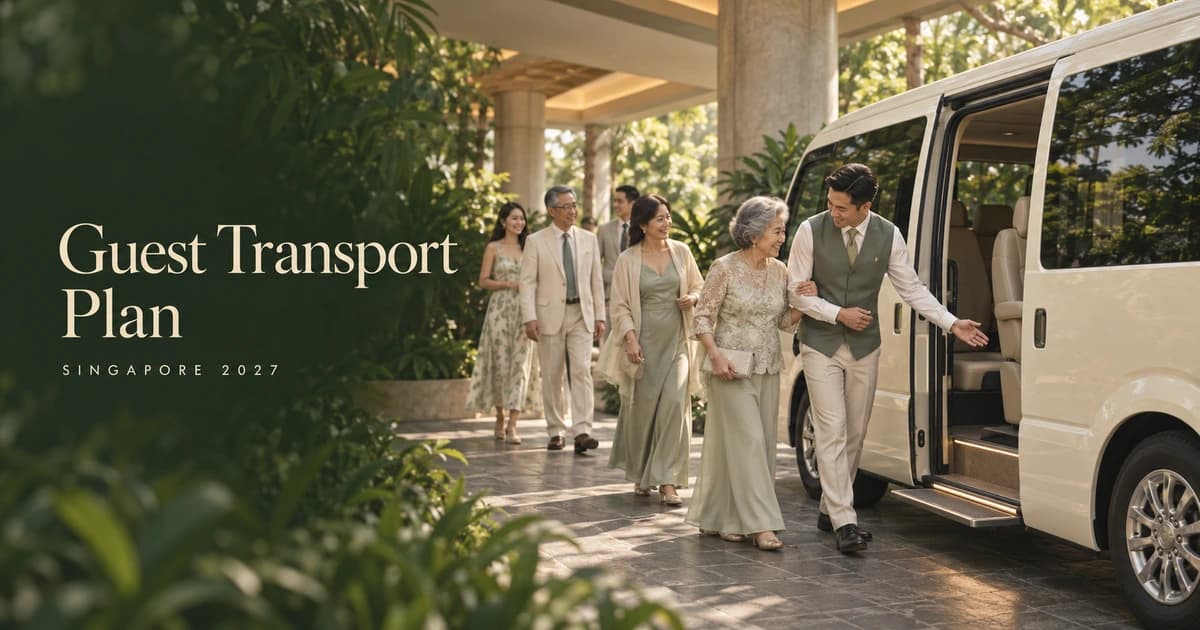
Start with the journey, not the bus
Your grandmother should not have to hunt for a hotel loading bay in the rain. Your friends should not discover, after the last banquet course, that the return shuttle only went one way. Wedding guest transport in Singapore is less about hiring an impressive vehicle and more about removing those small, stressful surprises.
This is a planning guide for 2027 weddings, prepared with official transport guidance checked on 29 September 2026. It is not a 2027 fare sheet or a promise that today's routes and access arrangements will remain unchanged. Reconfirm the details for your wedding date.
Separate guest transport from the bridal car. The couple's car may be occupied with photography, outfits and family stops; it should not quietly become the backup for twenty guests. Likewise, a photographer's vehicle is not spare passenger capacity unless that has been expressly agreed.
A shuttle earns its place when a group needs the same journey at the same time: relatives moving from a church to a banquet, overseas guests staying at one hotel, or guests reaching a venue with an awkward final stretch. For a central restaurant where most guests prefer independent travel, clear directions and a few pre-arranged family rides may work better.
Before requesting quotes, ask guests whether they need an outward ride, a return ride, both, or neither. Count the two directions separately. Someone may take your shuttle to the wedding and leave early with friends.
Check 1: Walk the actual MRT-to-door route
“Near an MRT station” is not a route description. Walk from the relevant station exit to the entrance guests will actually use, preferably at a comparable time of day. Check lift access, road crossings, shelter, slopes, resting points and the final approach to the ballroom. A convenient mall entrance might not be the hotel entrance shown in a navigation app.
LTA's inclusive public transport guidance states that public buses and trains are wheelchair accessible, with barrier-free access routes in all train stations and bus interchanges. That does not certify the pavement, private venue or chartered bus on your route. Check the whole journey, not just the train ride.
Make a short arrival note with:
- The station name, correct exit and a recognisable meeting landmark.
- A separate step-free route if it differs from the quickest route.
- The entrance name and a photograph that does not show identifiable guests.
- A wet-weather alternative and the transport coordinator's number.
For an HDB or BTO home stop before the banquet, check the estate's actual drop-off and waiting arrangements. Do not assume a large coach can enter a residential car park or wait along an access road. Ask the venue or relevant property manager to confirm a suitable location with the operator.
Check 2: Confirm parking, pickup and waiting separately
A passenger drop-off point, a coach waiting area and a car park are three different things. Ask your hotel or restaurant where each is permitted. Get an entrance pin and, if useful, a photograph of the agreed bay rather than sending the driver only a postal address.
For guests driving themselves, clarify which car park serves the function room, whether coupons are available, how they are distributed and what happens if the car park is full. Do not announce complimentary parking until the venue has confirmed the actual entitlement in writing.
For Sentosa, consult the official getting-to-Sentosa page and obtain date-specific instructions from your venue and operator. Ask separately about island entry, vehicle access, passenger unloading and coach parking. A car parking instruction is not a coach parking permission. This guide does not quote island admission or parking rates.
Choose a ride-hail pickup point that guests can find after dark, with a sheltered waiting option where available. Never promise that cars will arrive immediately or that a fare will stay fixed. A coordinator can help guests find the agreed bay without standing in a live traffic lane or trying to direct road traffic.
Check 3: Ask about access needs privately
“Elderly-friendly” is too vague for a booking. Ask the guest or their chosen helper what makes the journey comfortable. Can they manage vehicle steps? Do they need to remain seated in a wheelchair? Is there a walking aid, a stroller or space needed for a companion?
Do not assume a standard minibus has a lift, wheelchair restraints or a suitable boarding arrangement. Obtain written confirmation of the actual vehicle, equipment, trained assistance and capacity needed. A wheelchair space can change the available seating layout. If the operator cannot meet the requirement, arrange a suitable accessible vehicle instead of improvising on the day.
For children, confirm an age-appropriate, legally compliant restraint arrangement with the provider for the actual vehicle. Do not treat a child sitting on an adult's lap as an extra available seat. For every passenger, use the operator's confirmed seating and safety arrangements; keep aisles and exits clear.
Transport planning does not require a medical history. Record only the practical assistance requested, restrict it to people who need it, and agree how long the information will be kept. Never put diagnoses, phone numbers or a passenger list in a public wedding website or group screenshot.
Check 4: Build transfers into the wedding timeline
A church-to-banquet transfer includes more than driving. Guests need to finish conversations, collect belongings, reach the vehicle, board, travel and find their seats at the next venue. Your wedding-day timeline should show each of those stages.
Here is a purely illustrative planning exercise, not a travel-time estimate: if guests must be seated at 6.30pm, reserve 15 minutes for unloading and walking in, 45 minutes for the road journey, 15 minutes for boarding, and another 15 minutes of contingency. That works backwards to a 5pm boarding start and a 5.15pm departure. Replace every allowance with an operator-checked estimate for your route, date and guests.
Give the transport coordinator authority to handle a late passenger, but agree the limit in advance. For example, they could call once at the boarding deadline, then follow the departure rule you have communicated. A missing guest should not automatically delay the entire banquet. Guests who need additional assistance should have a planned boarding arrangement, not be treated as a timing problem.
If tea ceremony, ROM solemnisation and dinner happen at different locations, draw each journey as a separate leg. Label who needs it. Your parents may travel with the family while most friends join only for dinner. Avoid paying for a full-group transfer that exists only on a generic itinerary.
Check 5: Book usable capacity, not a headline seat count
Ask the operator to confirm usable passenger capacity for your actual luggage, equipment and access requirements. Count the onboard coordinator as a passenger. Keep walking aids, suitcases and any ceremony items in approved storage; do not fill seats or aisles with décor and then discover there is nowhere for people to sit.
Compare these service shapes before comparing totals:
| Arrangement | Useful when | What the written quote should clarify |
|---|---|---|
| One-way transfer | A group shares one origin and destination | Pickup window, waiting allowance, extra stops and delay charges |
| Outward and return transfers | Guests need both legs at fixed times | Both departure times, whether separate vehicles are used, cancellation terms |
| Repeated shuttle loop | Guests arrive in waves from one meeting point | Full round-trip time, boarding allowance and capacity per departure |
| Vehicle on standby | Timing is variable or several agreed moves are needed | Minimum booking period, standby location and overtime increments |
| Separate accessible ride | A guest needs a specific vehicle or boarding setup | Equipment, companion seating, assistance and both journey directions |
One vehicle making two trips is not the same as two vehicles leaving together. The second group must wait through the first journey, unloading and return trip before boarding. Check whether the venue has a comfortable waiting area and whether the second arrival would miss the ceremony.
Check 6: Compare complete costs, not advertised starting prices
There is no verified 2027 operator price list in this guide. Request itemised quotations for the same itinerary and compare the total payable in SGD. Check GST where applicable, any stated service charge, parking or entry costs, additional stops, after-hours charges, waiting time and overtime. Clarify whether these are included, excluded or payable only if triggered.
To make the arithmetic concrete, imagine a hypothetical quote of S$600 for the agreed transfers and an additional S$100 of clearly itemised charges: S$700 total. With 35 confirmed users, that is S$20 per person; with 20 users, it is S$35. These are invented budgeting inputs, not market rates or a vendor offer. They show why a smaller confirmed group can change the value of a shared coach.
Check payment dates, cancellation and rescheduling terms, vehicle substitution, the breakdown procedure and who authorises chargeable changes. Put a contingency line in your wedding budget, but do not count uncertain ang bao receipts as the money that will pay the transport deposit.
Check 7: Plan the last ride before the first pickup
The return journey deserves its own RSVP question and departure time. A banquet ending late does not mean every guest wants to stay until the final shuttle. Consider whether a small earlier family transfer and a later group departure would suit your guests better than one compulsory finish.
For anyone relying on public transport, check the operator's date-specific information for the actual route, direction and any interchange connections. Do not use a blanket “MRT runs until midnight” assurance. A last train from the departure station is not necessarily the last workable connection home.
Decide where the return shuttle ends. “To the MRT” and “to your hotel” are different promises. For a remote venue or a Sentosa celebration, confirm a fallback with the operator before the wedding; do not assume an unbooked taxi fleet will be waiting outside.
Guests who have been drinking should not be encouraged to drive. Offer clear pickup instructions and contact details for help arranging a safe journey. If someone becomes unwell or faces an immediate emergency, seek appropriate emergency assistance; the wedding shuttle is not an emergency medical service.
Check 8: Give one coordinator a small, useful manifest
Choose someone who is not simultaneously doing hair and makeup, carrying the rings or delivering a speech. Give them the operator's dispatch contact, the driver's contact when assigned, the venue contact, confirmed pickup pins, agreed departure rules and breakdown arrangements. Have a backup coordinator who can take over.
Use a restricted passenger list organised by journey leg. A household name, party count, boarding point, confirmation status and a necessary contact method may be enough. Keep access requests in a private note rather than broadcasting them to all passengers. Share with the operator only the details needed to provide the service, and remove temporary lists when their agreed purpose is complete.
Reconfirm numbers before the operator's change deadline. Release unused reservations through the coordinator, not through a public scramble for “spare seats”. Never oversell capacity on the assumption that some guests will not turn up. If someone opts out of the return journey, update that leg so nobody waits for them unnecessarily.
A guest message can be short and precise: “Your outward shuttle reservation is confirmed. Please meet at the named pickup bay shown in the attached pin at the stated boarding time. The bus leaves at the stated departure time. Your return reservation is listed separately. If your plans change, contact the transport coordinator.” Replace those labels with the actual agreed details before sending it; avoid burying changes in a long group chat.
Frequently Asked Questions
Do we need a shuttle for every wedding guest?
No. Match support to actual journeys and requests. Clear MRT directions, parking information and individual family rides can be sufficient for a well-connected venue. A shuttle is most useful when a confirmed group shares a route or when the final approach creates a practical obstacle.
Is a minibus automatically suitable for wheelchair users?
No. Confirm the exact vehicle, boarding equipment, wheelchair securing arrangements, companion seating and assistance with the provider and guest. Do not infer private-charter accessibility from the accessibility of Singapore's public buses, or assume that the guest can transfer out of their wheelchair.
Can we run the same bus twice to save money?
Possibly, but allow for the complete loop, including unloading, the return road journey and boarding again. Compare the second group's arrival time with the actual ceremony deadline. A lower quote is not useful if half the guests miss the event or have nowhere comfortable to wait.
Who should handle guests who miss the departure?
The named coordinator should follow the communicated departure rule and help explain the agreed alternative. Do not make the driver negotiate with several family members at once. Any additional paid journey should follow the authorisation arrangement agreed with the couple and operator.
How much should we budget for a wedding shuttle in 2027?
Use a written quote for your date, route, passenger needs and service hours rather than a generic internet range. Ask for the total payable, optional charges and cancellation terms. The S$700 calculation above is only a hypothetical comparison exercise, not a current or future Singapore transport rate.
Your final transport checklist
- Confirm outward and return passengers separately, including companions and coordinators.
- Walk the station-to-venue route and check the wet-weather alternative.
- Obtain approved pickup, unloading, waiting and parking arrangements.
- Confirm the actual vehicle's capacity, luggage space and required accessibility.
- Put boarding, travel, unloading and contingency into the event timeline.
- Compare complete written quotes and identify who approves extras.
- Recheck public transport connections and communicate the return destination.
- Give one coordinator the restricted manifest and operational contacts.
Add these decisions to your wedding planning checklist. Once everyone knows where to meet, when to leave and whom to call, the transport plan can quietly do its job while you enjoy the wedding.
Related Guides
The tool for this step
Compare Wedding Venues & Packages
133 venues, 1,008 packages — filter by budget, region, and capacity
Planning your own wedding? Get every step like this one in a free personalised checklist.
Start planning freeRelated Guides
Wedding Parents, Budget & Guest List Singapore 2027
Handle Singapore wedding decisions with parents using 8 practical scripts for budget contributions, guest-list quotas, traditions, ang bao and boundaries.
ROM vs Wedding Ceremony in Singapore: Do You Need Both? (2026)
ROM vs wedding ceremony — what's the legal difference, do you need both? Clear costs breakdown for Singapore couples planning their big day in 2026
Child-Free Wedding Etiquette Singapore 2027
Plan a child-free Singapore wedding with 8 invitation scripts, age cut-offs, family exceptions, RSVP handling, childcare ideas and seating rules.