Wedding Tea Dress and Kua Singapore 2026/2027
Choose a Singapore wedding tea dress or kua with rental tips, Si Dian Jin styling, ceremony movement, photos, fittings, and budget choices.
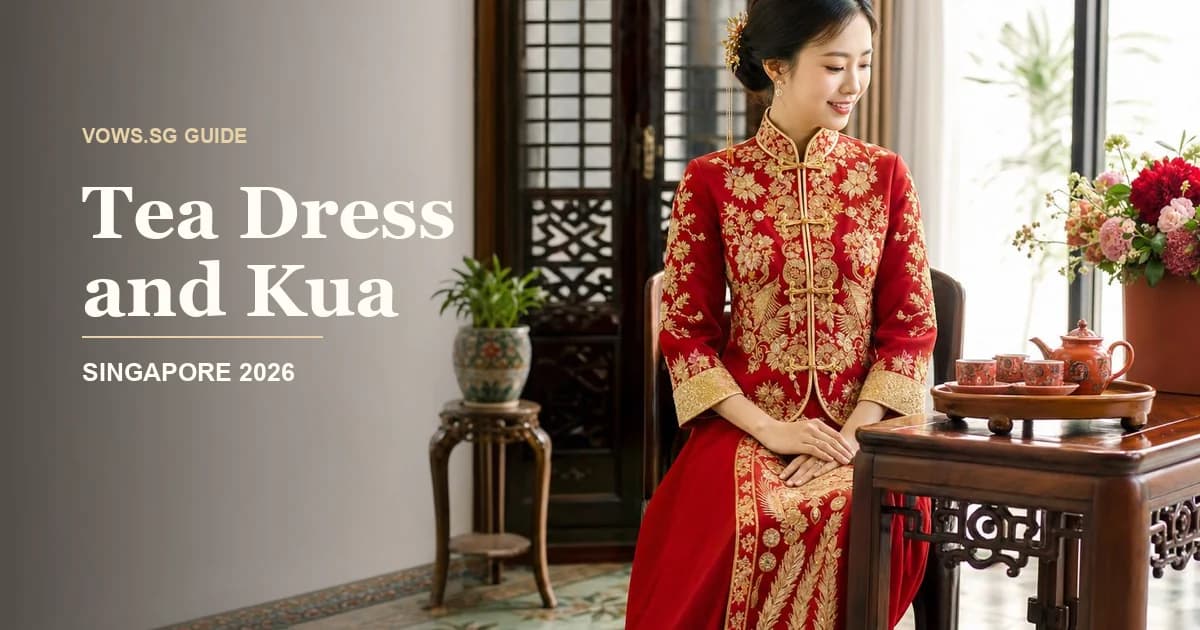
Kua Or Modern Tea Dress: The Real Choice
For many Singapore brides, the tea ceremony outfit is not just “one more dress”. It is the outfit your parents, grandparents, in-laws, aunties, uncles, and future WhatsApp family albums will remember. It also has to survive HDB lift lobbies, humid corridors, hotel room chaos, kneeling, standing, hugging, photo-taking, and sometimes a rushed car ride between both homes.
The main choice is usually between a traditional Chinese kua and a modern tea dress.
A kua feels ceremonial. It photographs strongly, carries cultural weight, and usually makes parents very happy. A modern tea dress feels lighter, softer, and more adaptable, especially if your wedding style is less traditional or you are trying to reduce outfit changes.
There is no one correct answer. The better question is: what does this outfit need to do for your actual wedding day?
If you are having a full Chinese tea ceremony with both families, Guo Da Li, Si Dian Jin, and plenty of elder relatives, a kua is usually the safer and more meaningful choice. If your tea ceremony is small, casual, or folded into ROM or lunch, a modern tea dress can work beautifully. If both sides have different expectations, settle this early before deposits are paid.
For the broader wedding sequence, pair this guide with the Chinese tea ceremony guide, Guo Da Li guide, and wedding planning checklist.
Kua Vs Modern Tea Dress
A kua is the traditional two-piece Chinese wedding outfit, usually red with gold embroidery. Common motifs include dragons, phoenixes, peonies, bats, clouds, and auspicious symbols. It tends to look formal, rich, and unmistakably bridal.
A modern tea dress is usually a red, champagne, pink, gold, or pastel dress worn for the tea ceremony. It may be cheongsam-inspired, A-line, midi length, qipao-style, or a lighter gown with modern tailoring.
| Choice | Best For | Watch Out For |
|---|---|---|
| Traditional kua | Formal tea ceremony, strong family tradition, heritage photos, Si Dian Jin styling | Can be warm, heavy, and less flexible for movement |
| Modern cheongsam tea dress | Brides who want Chinese influence with a cleaner silhouette | Fit must be excellent; tight cuts can restrict kneeling |
| Short or midi tea dress | ROM lunch, casual home tea ceremony, smaller weddings | May feel too casual for conservative families |
| Red evening gown | Banquet-ready look, fewer outfit changes | Can blur the line between tea ceremony and march-in styling |
| Bespoke modern kua | Brides who want tradition but not the standard rental look | Higher cost, longer timeline, less resale certainty |
The kua wins on symbolism and photo impact. The tea dress wins on comfort and versatility.
If you are stuck, ask yourself:
- Will grandparents or parents strongly expect a traditional red outfit?
- Will the tea ceremony be photographed properly, or only captured casually?
- Are you moving between two homes, a hotel, ROM, and restaurant on the same day?
- Do you want this outfit to appear in framed family photos?
- Are you likely to re-wear or keep the dress after the wedding?
If the outfit is mainly for family ritual, choose the kua. If it needs to work across tea ceremony, ROM, lunch, and casual portraits, a modern tea dress may be the smarter buy.
Rental Or Made-To-Measure
Rental is the practical default for most couples. Made-to-measure is for brides who care about exact fit, specific design, sentimental keeping, or unusual sizing.
In Singapore, many bridal studios include a kua or tea dress as part of a broader gown package. If not, set aside a few hundred dollars for a simple rental, and more for premium embroidery, newer pieces, or elaborate designs. Made-to-measure can easily move from high hundreds into several thousand SGD depending on fabric, handwork, beading, lining, and tailoring complexity.
Do not compare only by headline price. Compare by what is included:
- Number of fittings
- Alteration policy
- Cleaning fees
- Damage deposit
- Rental duration
- Pickup and return timing
- Accessories included
- Whether groom’s matching outfit is available
- Whether GST is already included
- Whether weekend or peak-date surcharges apply
When Rental Makes Sense
Rent if you want something beautiful without turning it into a major project. This is especially sensible if the kua is worn for only one to two hours in the morning before you change into your ROM dress or white gown.
Rental is also good if:
- Your bridal package already includes one tea ceremony outfit
- You are not sentimental about keeping the outfit
- Your wedding date is within the next six months
- You are okay choosing from available sizes and designs
- You want to spend more budget on photography, banquet, or rings
The main downside is fit. Kua jackets are more forgiving than body-hugging cheongsams, but sleeve length, shoulder width, waist, and skirt length still matter. If you are petite, very tall, pregnant, or between sizes, book fittings earlier.
When Made-To-Measure Makes Sense
Made-to-measure is worth considering if the outfit is a major part of your wedding identity. Some brides want to keep the dress, pass it down, or design something that reflects their family and personal style.
It also makes sense if:
- You want a modern kua in a non-standard colour
- You prefer lighter fabric because you overheat easily
- You need a specific neckline for jewellery or modesty
- You want exact proportions for photos
- You have a two-day wedding and will wear it more than once
- You want to coordinate with the groom’s outfit properly
The tradeoff is time and decision fatigue. Once you customise embroidery, fabric, collar height, sleeve length, buttons, lining, and silhouette, it becomes a real design project. Start early and budget properly.
Si Dian Jin Styling
Si Dian Jin is traditionally associated with Teochew weddings, but many Singapore families now treat it more broadly as a meaningful jewellery gift from the groom’s family. If your family observes it, check expectations before choosing your neckline and colour.
Read the full Si Dian Jin guide first if you are unsure what pieces are expected.
For styling, the key is balance. Traditional kua embroidery is already visually rich, so the jewellery should frame the bride rather than fight the outfit.
Good pairings include:
- High-collar kua with earrings, bracelet, and ring, keeping the necklace subtle
- Lower neckline tea dress with a stronger necklace
- Plain modern cheongsam with more visible gold jewellery
- Red or champagne dress with yellow gold for a classic family-photo look
- Minimal hair accessories if the earrings are large
Avoid putting every shiny thing on at once unless that is the family expectation and you genuinely like the look. A heavy kua, large necklace, statement earrings, bangles, hairpiece, and bouquet can feel crowded in close-up photos.
Also check the practical side. Bangles can knock against teacups. Long earrings can snag on lace or hair. A necklace may twist when you kneel and stand repeatedly. Try the full look at home before the wedding day, not five minutes before your photographer arrives.
Movement, Heat, And Real Singapore Logistics
A tea ceremony outfit must move. This sounds obvious until you are trying to kneel on a cushion in a tight cheongsam while holding a cup of hot tea, with five relatives filming from different angles.
Singapore weddings are humid, rushed, and full of transitions. You may be moving through:
- HDB corridors and void decks
- Narrow BTO rooms with family gathered around
- Carparks and hotel drop-off points
- MRT-adjacent restaurants for lunch ceremonies
- Hotel suites where makeup, gowns, relatives, and photographers all compete for space
- Restaurant private rooms with tight table layouts
A very heavy kua looks amazing but can feel warm quickly, especially during a morning gatecrash and home tea ceremony. A slim modern tea dress looks elegant but may restrict sitting, kneeling, and climbing into cars.
Before confirming the outfit, test these movements:
- Sit down fully
- Kneel and stand without using both hands
- Raise your arms enough to hug relatives
- Walk up and down steps
- Sit in a car without the skirt riding too high
- Hold a tea tray or teacup naturally
- Turn your neck comfortably for photos
If the outfit fails two or more of these, it may still be beautiful, but it is not practical for your schedule.
For hot homes or older flats without strong air-conditioning, lighter lining matters. If your ceremony is at both parents’ homes before lunch, tell your makeup artist and photographer the exact locations. Travel time is not just distance on Google Maps; it includes waiting for lifts, parking, getting family assembled, and finding the right block.
Photo Impact
The kua photographs strongly because it gives instant context. Even in a simple HDB living room, a red and gold kua signals ceremony, family, and tradition. It also stands out against white walls, wood furniture, hotel carpets, and banquet backdrops.
Modern tea dresses can be just as beautiful, but they need more intentional styling. The silhouette, hair, jewellery, bouquet, and family setup matter more because the outfit may not immediately read as “traditional wedding”.
If photos are important, think in scenes:
- Couple portraits before leaving home
- Bride with parents before tea
- Bride and groom serving tea together
- Four-parent photo after tea ceremony
- Jewellery close-up with Si Dian Jin
- Full-length outfit shot before changing
- Group photo with siblings and grandparents
Ask your photographer to capture the outfit before the ceremony gets messy. Once ang bao packets, tea sets, bags, makeup pouches, shoe boxes, and breakfast packets appear in the background, the visual impact drops quickly.
For kua photos, clear one wall or sofa area before the wedding morning. For modern tea dresses, choose a clean corner with good natural light. If you are using a hotel room, remove plastic bags and garment covers before the photographer arrives.
Dialect And Parent Expectations
This is the part couples sometimes underestimate. The tea ceremony outfit is rarely just about the bride’s taste. It can carry family meaning, especially for parents who see the wedding as a cultural milestone.
Different families may have different expectations around colour, jewellery, ceremony order, who serves tea first, and what the bride should wear. Dialect group can matter, but family habit matters more. Two Teochew families may not practise things the same way. One Hokkien family may be very traditional, while another may be relaxed.
Ask both sides early:
- Do you expect a traditional kua?
- Is a modern red dress acceptable?
- Are there colours to avoid?
- Will Si Dian Jin be presented or worn during tea ceremony?
- Is there a preferred order for serving tea?
- Will grandparents expect kneeling?
- Are there relatives who must be included?
- Should the groom wear a matching ma gua, suit, or something else?
Do not ask this only through casual hints. Have a proper conversation before booking. Many conflicts happen because couples assume “anything also can”, then discover one parent had a very specific picture in mind.
If your parents and in-laws disagree, try separating symbolism from styling. For example, you could wear a traditional kua for the main family tea ceremony, then change into a lighter modern dress for ROM lunch. Or choose a modern kua silhouette that still feels red, auspicious, and formal enough for elders.
Outfit Changes Around Gatecrash, ROM, Banquet, And Lunch
The outfit plan should follow the day’s flow, not the other way around.
A common Singapore wedding day may include gatecrash, fetch bride, tea ceremony at bride’s home, tea ceremony at groom’s home, ROM, lunch or dinner banquet, first march-in, second march-in, and after-party photos. Trying to squeeze four outfits into one day can look glamorous on paper and stressful in real life.
If You Have Gatecrash
Most brides do not wear the kua for gatecrash games. It is too warm, too precious, and too restrictive. A robe, morning dress, or simpler outfit works better while makeup and hair are still being finished.
A practical flow:
- Morning robe or getting-ready outfit
- White gown or light dress for gatecrash and fetch bride
- Kua or tea dress for tea ceremony
- ROM dress or white gown for solemnisation
- Banquet gown for march-in
If your gatecrash and tea ceremony happen in the same home with very little time between, choose an outfit change plan that your bridesmaids can actually manage. Buttons, hooks, hairpieces, and jewellery take longer than expected.
If ROM Is On The Same Day
If your ROM is before the tea ceremony, your solemnisation outfit may be the emotional main look. If ROM is after tea ceremony, decide whether you want to change back into a white dress or keep the tea dress.
A modern tea dress can be efficient here. It may work for both tea ceremony and ROM, especially for lunch solemnisation in a restaurant private room. A traditional kua can also work, but some couples prefer a lighter look for signing photos.
For more budgeting context around outfit stacking, see the wedding cost guide.
If You Have A Hotel Or Restaurant Banquet
Hotel and restaurant timelines can be unforgiving. Makeup touch-ups, coordinator briefings, AV checks, family photos, and march-in rehearsals all compete for the same window.
If your tea ceremony is in the afternoon before a dinner banquet, avoid an outfit that takes 25 minutes to change out of. If your second march-in gown is complicated, keep the tea dress simpler.
Also check service charge and GST when comparing packages that include gown rental, photography hours, makeup artist top-ups, or extra styling. A small-sounding add-on can feel less small once taxes and peak-date charges come in.
Colour, Cut, And Fabric Choices
Red is the safest colour for most Chinese tea ceremonies. Gold, champagne, blush, and pink can also work, especially for modern tea dresses. Black, white, and very pale neutrals may be sensitive for some elders, even if they look chic.
For kua, the decision is usually about embroidery density and cut. Dense embroidery looks luxurious but adds weight. Lighter embroidery is easier to wear and may suit smaller homes or shorter ceremonies.
For tea dresses, the decision is about silhouette:
- A-line is forgiving and easy to move in
- Cheongsam cuts are elegant but need precise fit
- Midi length is practical for walking and kneeling
- Long gowns look formal but can be warm
- Sleeveless dresses are cooler but may need parent approval
- High collars look traditional but can feel tight in heat
If you are wearing Si Dian Jin, avoid necklines that hide the jewellery completely unless that is intentional. If you are self-conscious about arms, choose sleeves that still allow you to lift teacups and hug relatives.
Fitting Timeline
Do not leave tea ceremony outfit decisions to the final month if family expectations are involved. Even rental pieces need selection, alteration, and pickup coordination.
| Timeline | What To Do |
|---|---|
| 9 to 12 months before | Ask both families about kua, tea dress, colours, jewellery, and ceremony expectations |
| 6 to 9 months before | Shortlist rental or made-to-measure; check if bridal package includes a kua |
| 4 to 6 months before | Confirm outfit, groom’s coordination, and Si Dian Jin styling |
| 2 to 3 months before | First fitting or alteration check; test sitting and kneeling |
| 3 to 4 weeks before | Final fitting with shoes, jewellery, and undergarments |
| Wedding week | Confirm pickup, return, steaming, emergency kit, and who is responsible |
| Wedding day | Assign one bridesmaid or family member to handle outfit, jewellery, and ang bao safekeeping |
If you are made-to-measure, build in buffer. Tailoring delays, embroidery changes, weight changes, pregnancy, or shoe changes can affect fit. If you are renting, take photos and videos during fitting so you remember exactly how it should sit.
Bring these to fittings:
- Wedding shoes or similar heel height
- Planned bra or shapewear
- Si Dian Jin or similar jewellery
- Hair reference if neckline depends on hairstyle
- A trusted person who will tell you if the fit is off
- Phone camera for sitting, walking, and side-view checks
Common Mistakes To Avoid
The biggest mistake is choosing only for photos. Yes, the outfit should look beautiful. But the tea ceremony is an active ritual. You will move, serve tea, receive jewellery, hug people, take photos, and change quickly.
Avoid these traps:
- Choosing a dress so tight you cannot kneel comfortably
- Forgetting to ask parents before booking a non-red dress
- Wearing heavy jewellery without testing it with the neckline
- Planning too many outfit changes for a tight hotel schedule
- Assuming the bridal package includes alteration, cleaning, or accessories
- Leaving outfit pickup to the wedding morning
- Not assigning someone to hold jewellery and ang baos
- Choosing a long train for a cramped HDB home ceremony
- Wearing new shoes that make stairs and car rides painful
- Forgetting that Singapore heat makes heavy fabric feel heavier
Another common issue is groom coordination. The groom does not need to match perfectly, but he should not look like he wandered in from another event. A dark suit, mandarin-collar jacket, ma gua, or coordinated tie can all work. Just decide the level of tradition together.
Practical Decision Guide
If your parents are traditional and the tea ceremony is important, choose a kua. You will not regret having the photos.
If both families are relaxed and you want one outfit for ROM and tea ceremony, choose a modern tea dress.
If you are petite or worried about looking overwhelmed, try a lighter kua or modern cheongsam rather than the heaviest embroidery available.
If you overheat easily, prioritise lighter fabric, looser fit, and fewer accessories.
If you care deeply about heirloom value, consider made-to-measure.
If your budget is already stretched by banquet, photography, housing renovation, or BTO costs, rent the outfit and spend the savings where you will feel it more.
Wedding Tea Dress And Kua Checklist
Use this before confirming your outfit:
- Ask both families whether a traditional kua is expected
- Check if dialect customs affect colour, jewellery, or ceremony order
- Confirm whether Si Dian Jin will be worn during tea ceremony
- Decide whether the outfit is for tea ceremony only, or also ROM/lunch
- Compare rental and made-to-measure based on total cost, not headline price
- Check GST, service charge, cleaning, damage deposit, and alteration terms
- Test sitting, kneeling, standing, hugging, and car movement
- Bring shoes, undergarments, and jewellery to fitting
- Coordinate groom’s outfit early
- Plan the outfit change sequence around gatecrash, ROM, tea ceremony, and banquet
- Keep travel time realistic for HDB blocks, lifts, parking, MRT access, and hotel movement
- Clear a clean photo corner at home or hotel
- Assign one person to manage jewellery, ang baos, outfit bag, and return items
- Confirm pickup and return timing in writing
- Pack safety pins, fashion tape, tissues, mini fan, blotting paper, and spare hooks if needed
A good tea ceremony outfit should make you feel bridal, respectful, and still like yourself. Whether that means a full red-and-gold kua or a modern tea dress, choose the one that fits your families, your schedule, and the kind of wedding day you actually want to live through.
The tool for this step
Compare Wedding Venues & Packages
133 venues, 1,008 packages — filter by budget, region, and capacity
Planning your own wedding? Get every step like this one in a free personalised checklist.
Start planning freeRelated Guides
Wedding Rings Singapore 2026/2027: Metals, Sizing & Prices
Choose wedding rings in Singapore by comparing 3 common metals, prices from jewellers' own sites, finishes, sizing, engraving, custom timelines, warranties, and daily wear.
ROM Decoration Singapore 2026/2027: Packages & Prices
Compare Singapore ROM and solemnisation decoration options for 2026/2027: published packages from S$480++ to S$2,888, arch and signing-table costs, and ROM's no-decoration rule.
Wedding Invitation Card Printing Singapore 2026/2027
Plan Singapore wedding invitation card printing with paper types, hot stamping, bilingual copy, quantities, timelines, and cost ranges.