Restaurant Weddings Singapore 2027: Buyout Costs
Compare Singapore restaurant wedding buyouts with 8 checks for minimum spend, room hire, exclusive use, guest capacity, menus and hidden charges.
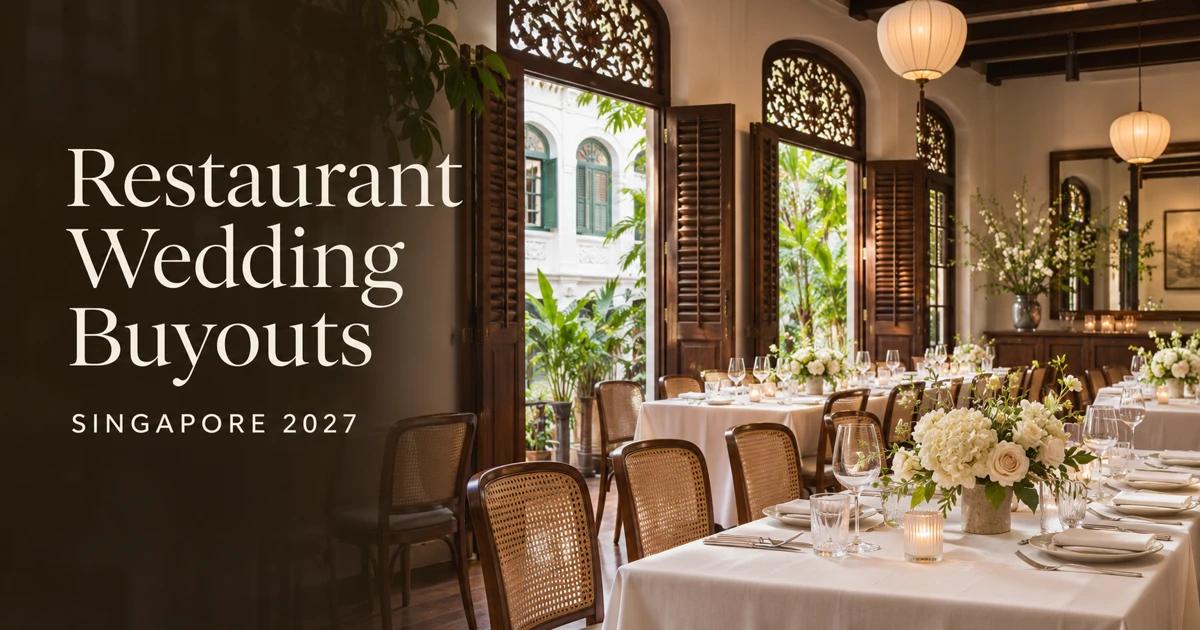
A restaurant wedding can feel wonderfully personal: your favourite food, familiar faces and a room that does not need ballroom-sized décor. The tricky part is the booking language. A private room, an exclusive dining area and a full restaurant buyout can sound similar in a sales conversation while buying very different things.
For a 2027 Singapore wedding, decide what you need to make private before comparing prices. Then ask for a written, date-specific quotation with the floor plan attached. The examples below are budgeting illustrations, not advertised venue packages or guaranteed 2027 rates. Venue pages were checked on 18 November 2026; your signed quotation must settle the actual terms.
1. Choose the level of privacy you actually need
A private room suits a meal where conversation is the main event. A partial buyout may give you one dining hall while the rest of the restaurant remains open. A full buyout can offer a more cohesive celebration, but do not assume that every terrace, corridor or adjoining room comes with it.
| Booking format | What to establish | Main trade-off |
|---|---|---|
| Private room | Door, sound separation, room fee and dining capacity | Intimate, but ceremony space may be limited |
| Partial buyout | Exact exclusive zone and shared entrances or facilities | More space without paying for the entire restaurant |
| Full buyout | Included indoor and outdoor areas, access hours and public closure | Greater control, with a potentially larger spend commitment |
Ask the manager to shade your exclusive areas on the floor plan. Include the reception table, solemnisation space, toilets, bridal changing area and access route. If other diners will walk through your reception, decide whether that matters to you before paying a deposit.
For a shorter guest list, read our micro-wedding planning guide before committing to an entire venue. A small wedding does not automatically need a buyout, and paying for unused space rarely makes the day more meaningful.
2. Separate minimum spend, rental and menu pricing
These are different billing models, not interchangeable labels.
Minimum spend is a required amount of eligible spending. If the agreed food and drinks reach that threshold, there may be no shortfall. However, a venue can also charge rental or other fees separately. Confirm what counts: alcohol, children's meals, vendor meals, menu upgrades and corkage may be treated differently.
Room hire or rental is a charge for space or time. It may sit on top of every meal and beverage ordered. Do not assume that spending more on dinner cancels the rental.
Per-person packages price the included menu and services by guest. A minimum number of paying guests, a minimum spend or a separate hire fee may still apply. Ask which conditions apply together.
Official venue wording shows why this distinction matters. On 18 November 2026, Gedung Kuning's FAQ described its private-room charge as being “on top of the food & beverage orders” and said a rental fee applies to exclusive buyout events. Artemis Weddings' FAQ described exclusive bookings as “based on a minimum spend rather than a guest count”. These are dated examples of two charging structures, not promises about your wedding date or an all-in price comparison.
Request a quote with separate lines for eligible food and beverage, minimum-spend shortfall, rental, optional services, service charge and GST. If the salesperson says something is waived, have that waiver written into the same document.
3. Work through 30, 60 and 100 guests
Use the same guest count and inclusions when comparing restaurants. Comparing one venue's food-only quote with another's food, drinks and room hire will make the cheaper-looking option misleading.
The following figures are invented arithmetic examples, not market ranges. Each assumes a single eligible food-and-beverage rate, no separate rental and no other charges. The illustration applies 10% service charge, then 9% GST; confirm the actual rates, taxable items and charging basis in your quotation, especially for a future wedding.
| Example | Eligible menu total | Assumed minimum spend | Shortfall | Subtotal before charges | Illustrated total |
|---|---|---|---|---|---|
| 30 guests at S$150 | S$4,500 | S$6,000 | S$1,500 | S$6,000 | S$7,194 |
| 60 guests at S$180 | S$10,800 | S$10,000 | S$0 | S$10,800 | S$12,949.20 |
| 100 guests at S$160 | S$16,000 | S$18,000 | S$2,000 | S$18,000 | S$21,582 |
Here, the first row costs S$239.80 per guest after the illustrated charges—not S$150. The minimum spend, rather than the menu rate, drives the result. The formula used is the greater of eligible spending and minimum spend, multiplied by 1.10 and then 1.09. Real contracts can treat shortfalls or individual fees differently.
If a quote instead adds S$2,000 rental to S$10,800 food and beverage, the subtotal becomes S$12,800. Under the same illustrative charges it becomes S$15,347.20. That is not equivalent to a S$10,800 all-inclusive commitment.
Ask whether a shortfall can be used for approved upgrades before ordering more. Some couples would rather improve the menu; others prefer a smaller room. Do not assume unused spending can be refunded, carried forward or converted into takeaway meals.
Keep the venue commitment separate from attire, photography, flowers and your HDB or BTO budget. Ang bao contributions are uncertain; plan the deposit and balance around money you can actually pay without them.
4. Confirm capacity for each part of the wedding
A restaurant's headline capacity is not necessarily its seated ceremony capacity. Dinner tables, a signing table, aisle, photographer and accessible walking routes all need space.
Ask for two layouts: one for the solemnisation and one for dining. Then ask who moves the furniture, how long the change takes and where guests wait. A 60-person meal can be comfortable while the same 60 people cannot all sit facing the couple for the ROM ceremony.
During the visit, check sightlines from the least attractive seats rather than only the bridal table. Can grandparents hear the vows? Will a pillar block the speeches? Can a wheelchair user reach the dining area and toilet without navigating a service passage? Confirm the actual route, not just whether a lift exists somewhere in the building.
Use the venue comparison tool to organise your shortlist, then verify the room configuration directly. The questions to ask your wedding venue guide can help turn a pleasant viewing into a useful contract discussion.
5. Make the rain plan part of the booking
An outdoor terrace is lovely until it becomes your only ceremony space during a downpour. Ask where everyone goes if rain starts before the vows, not merely whether umbrellas are available.
Check whether the indoor fallback fits the full guest list seated, whether dining tables remain in place, and whether the alternative changes the look or timing of the ceremony. A covered area may still be affected by wind-driven rain or heat.
Name the person who decides to move indoors and agree on a decision time. Give the solemniser, photographer and decorator the same plan. Do not leave your parents or bridal party to negotiate furniture moves while guests are arriving.
Singapore's travel logistics matter too. Look at sheltered access from the drop-off point, the walk from the MRT, parking arrangements and where older relatives can wait. A beautiful entrance does not help much if everyone reaches it soaked.
6. Match the food and drinks to your guests
Choose a restaurant because its food suits your celebration, not only because the photographs look good. A tasting is a chance to test portion sizes, pacing and how dietary needs are handled.
Ask how children's meals, vendor meals and guests who do not drink affect the commitment. If guests choose their mains in advance, establish the deadline and how late changes are handled. Check whether a menu supplement applies only to people choosing that dish or to the whole party.
For Muslim guests, do not treat “no pork, no lard” as equivalent to halal certification. Verify the relevant certification or catering arrangements and discuss what your guests are comfortable with. For allergies, get the restaurant's handling limitations in writing rather than promising an allergen-free meal yourself.
For alcohol, compare the complete bill:
- Bottle size and corkage charge, including applicable taxes and service charge.
- Any purchase required to qualify for a corkage waiver.
- Whether corkage or outside bottles contribute to minimum spend.
- Charges for ice, mixers, glassware and service, if any.
- Last orders, unopened bottles and who authorises extra purchases.
Give one trusted person spending authority with a clear limit. “Keep everyone happy” is not a drinks budget.
7. Check access, sound and supplier arrangements
Your booking hours should cover the actual event, while the written access schedule should also cover setup and teardown. Ask when the florist, photographer, AV supplier and bridal party can enter. A lunch service before your dinner may leave less setup time than you imagine.
Run a practical timeline backwards from the first course. Include guest arrival, ROM solemnisation, family photographs and the tea ceremony. If your parents expect several family groups or dialect-specific customs, leave enough time rather than treating the ceremony as a quick transition between courses.
Ask about microphones, music connections, screen visibility and an AV test. Confirm sound limits and the time music must stop. A buyout does not remove building rules or give a live band unrestricted volume.
External suppliers also need workable loading arrangements, electrical access and an agreed removal time. Check décor restrictions, storage, rubbish removal and potential cleaning charges. If a supplier cannot finish within the available window, solve that before signing—not in the loading bay on your wedding day.
8. Protect the booking in writing
The most useful comparison is the total commitment attached to your actual date, hours, floor plan and guest count. Ask how long the quotation remains valid and whether a tentative hold protects the date.
Before paying, check the deposit, payment schedule, cancellation terms, postponement policy and final guaranteed guest-count deadline. Establish what happens if attendance falls, if you add guests, or if the restaurant proposes a different room or menu. Minimum spend and cancellation liability are separate questions.
Keep the quotation, floor plan and written clarifications together. Ask the venue to confirm which document controls if package brochures and the contract conflict. A friendly message can be helpful evidence, but you do not want essential inclusions scattered across several chats.
Restaurant weddings can be excellent value when the space and food genuinely match your priorities. They are not automatically cheaper than hotels once rental, drinks, styling and coordination are counted. Compare like for like and choose the commitment you can comfortably carry.
Frequently Asked Questions
Is a full restaurant buyout necessary for a small wedding?
No. A private room or exclusive dining area may provide enough privacy for your plans. Choose a full buyout when the ceremony, speeches, guest circulation or atmosphere genuinely needs it, and confirm exactly which spaces become exclusive.
Does meeting minimum spend remove the venue rental?
Not necessarily. Some contracts use minimum spend as the main commitment; others add rental or room hire. Ask for both items to be shown explicitly, including a written zero or waiver where applicable. Never infer the answer from a per-person menu price.
Can fewer guests make the final bill smaller?
Only if the contract allows it. A minimum spend or guaranteed paying guest count can keep the commitment unchanged even when attendance drops. Check the final-number deadline and permitted adjustments before sending invitations, then budget around the contractual amount.
Does a restaurant booking include the ROM solemnisation arrangements?
Do not assume so. Venue space, a signing table and a microphone are separate from your marriage application, solemniser arrangements and legal requirements. Confirm the venue's inclusions and check the applicable ROM process independently; a dinner reservation does not arrange the solemnisation for you.
Can we rely on these examples for a 2027 quotation?
No. The arithmetic is illustrative, and the venue wording was checked in November 2026. Request a fresh written quotation for your date, guest count, menu and exclusive areas. Check validity dates and all applicable charges before paying a deposit.
Your before-deposit checklist
Before you commit, make sure you can answer yes to these:
- Our exclusive areas are marked on an agreed floor plan.
- Dining, seated ceremony and wet-weather capacities work for our guests.
- Minimum spend, rental and all extra charges are separately explained.
- We know what spending counts towards the minimum and how a shortfall is billed.
- The menu, dietary arrangements and drinks rules suit our families.
- Setup, event, last-order and teardown times work for our suppliers.
- Deposit, guest-count, cancellation and postponement terms are in writing.
- We can pay the contractual commitment without relying on ang bao receipts.
Take this checklist to the viewing, then ask for one consolidated quotation. The goal is simple: a restaurant celebration that feels relaxed because the important details were settled before the day.
Related Guides
The tool for this step
Compare Wedding Venues & Packages
133 venues, 1,008 packages — filter by budget, region, and capacity
Planning your own wedding? Get every step like this one in a free personalised checklist.
Start planning freeRelated Guides
ROMM Registration Singapore 2027: Nikah Checklist
Plan your Singapore ROMM application with a nikah checklist covering wali, witnesses, Kadi arrangements, documents and ceremony-day preparation.
ROM for Foreigners Singapore 2027: Documents & Steps
Plan a Singapore civil marriage with a foreign partner: check documents, stay rules, translations, MOM approval and the separate ICA process.
Auspicious Wedding Dates in Singapore (2027 & 2028 Guide)
Auspicious wedding dates for 2027 and 2028 in Singapore: the days two almanacs agree on, with Ghost Month, Qing Ming and Chinese New Year dates and practical booking advice.